The Historical Museum
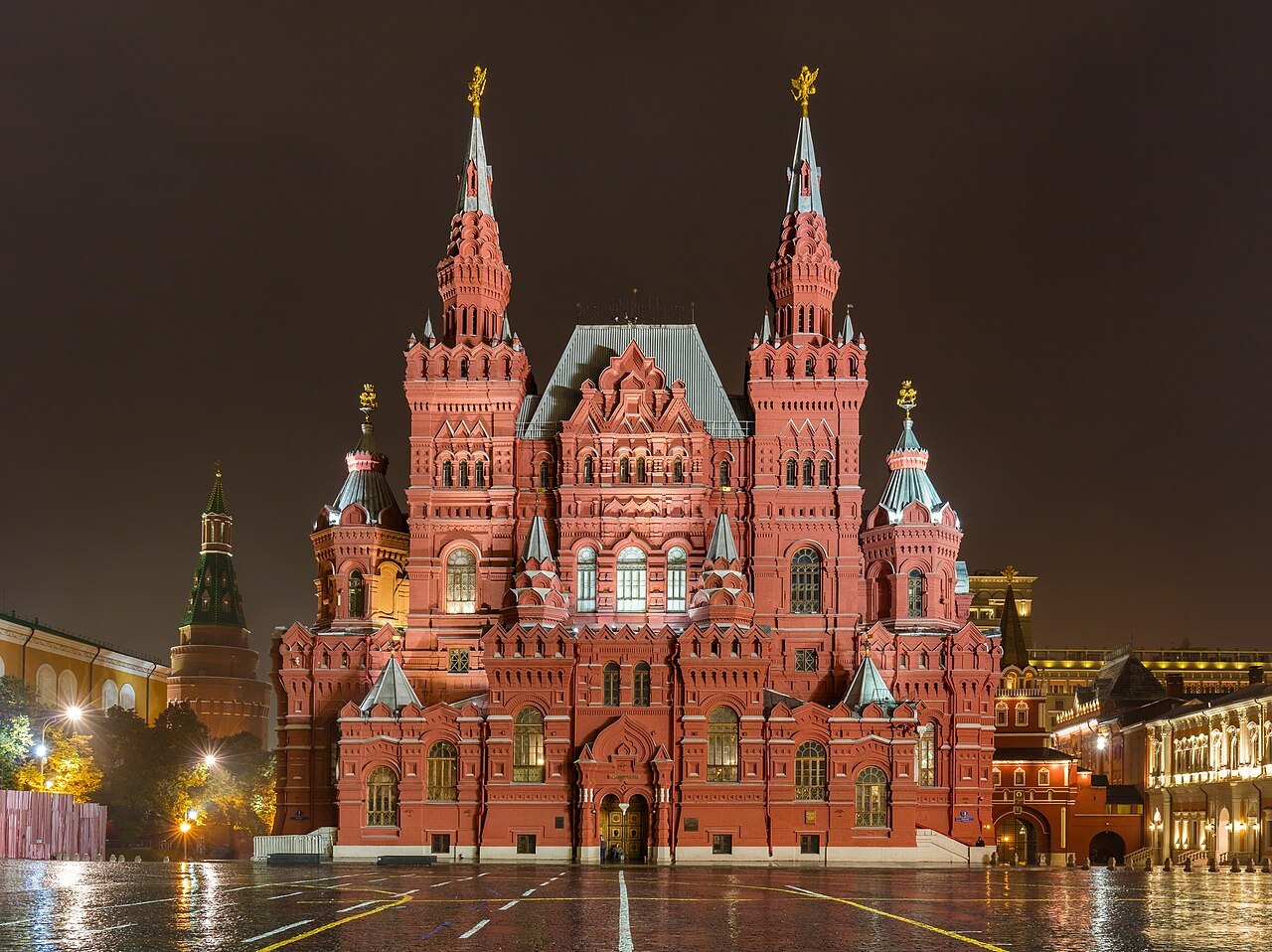
A dugout boat some 3,500 years old; the Mstislav Gospel of the early 12th century; the helmet of Prince Yaroslav Vsevolodovich; a Blaeu globe; personal belongings of Peter the Great. Look up: the halls themselves are painted after Old Russian models and count as an exhibit.
Go round from hall 1: the dugout boat, then the Mstislav Gospel and the helmet of Yaroslav Vsevolodovich, on to the Blaeu globe and Peter the Great.
Reference
Vasily Klyuchevsky, “A Course in Russian History” — the objects in the cases make sense once you know what they belong to.
| Mon–Wed, Sun today | 10:00–19:00 |
| Thu–Sat | 10:00–21:00 |
Getting there — partly. Neither Okhotny Ryad nor Teatralnaya has a lift. By wheelchair, surface transport to Red Square or a taxi. Moscow metro stations almost never have lifts to the platform, except on the Big Circle line and the MCC. A wheelchair user is better served by the surface buses, which are low-floor across the centre.
For the seventy-fifth year since the first Novgorod letter, found on 26 July 1951 in the Nerevsky dig. More than 1250 have been found since; among them the school exercises of the boy Onfim, with drawings that have no equal in medieval Europe. What the Vindolanda tablets are to Roman Britain, these are to medieval Rus — the writing of ordinary people, kept by wet ground. In the State Rooms, one month only.
A century of the country’s largest photographic service, which shot the news on the day it happened. Shown in two spaces of the Historical Museum: the Resurrection Gate and the Artillery Yard.
A hundred artists, designers and makers from across Russia, chosen by the project’s curator. This year’s theme is the image of the future held by those who work with the inheritance of their forebears. In the exhibition complex on Revolution Square.
Money in The Master and Margarita: ancient Judaea and Moscow of the 1920s–30s, set object against object. For Bulgakov’s 135th anniversary.
If it was the object rather than the event that held you at the History Museum, the Museum of Moscow does the same for a single city — the one under your feet.
If you reached the halls of 1812 and wanted to see the whole of it, the panorama on Kutuzovsky shows a single day from a single point.