Art · since 1856

The Tretyakov Gallery
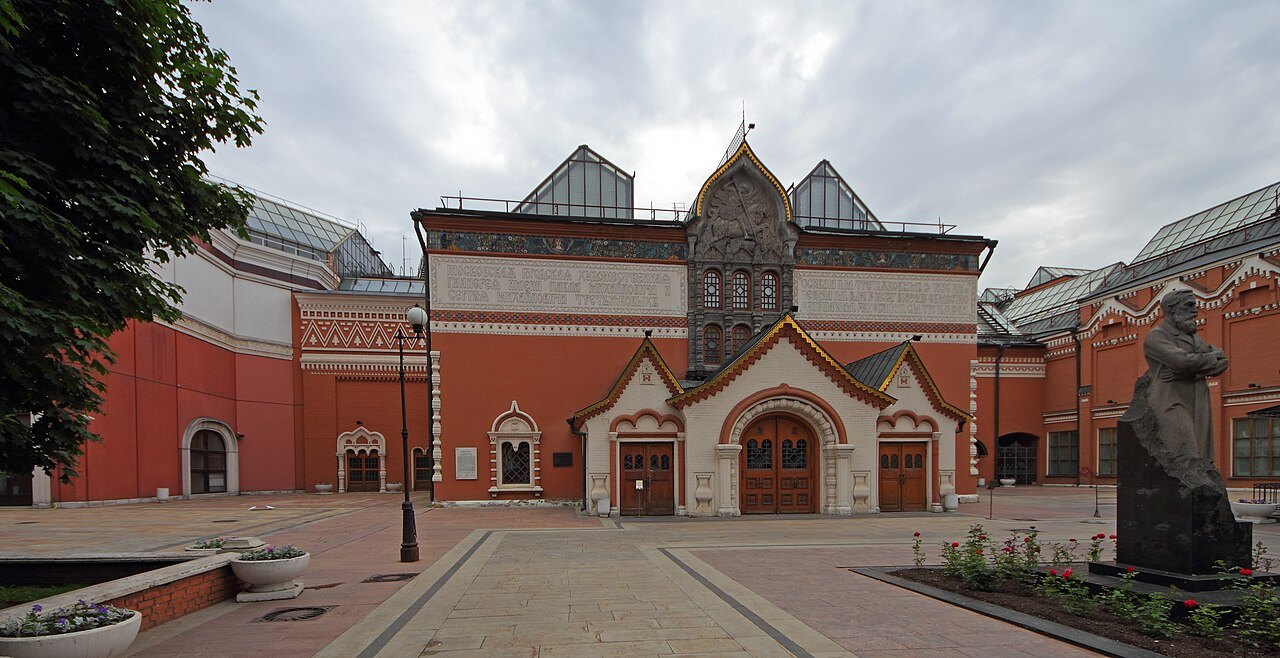
The State Tretyakov Gallery
original name: Государственная Третьяковская галерея
world-class
Russian art of the 11th to early 20th century is nowhere else assembled so fully — only the Russian Museum compares. But the canon was formed here: Tretyakov bought from living artists what he himself thought mattered, and one man’s private judgement became what we now call the Russian school. Seeing the 19th century elsewhere means seeing fragments.
Minimum route
2–3 hours
Founded
1856
Ticket
from 700 ₽ ≈ £6
Today
10:00–21:00
The Tretyakov Gallery
A.Savin, CC BY-SA 3.0 · Wikimedia Commons
What to see

Ivanov’s The Appearance of Christ Before the People in its own hall; Surikov’s Boyarynya Morozova and Morning of the Streltsy Execution; Repin’s Ivan the Terrible and His Son; Serov’s Girl with Peaches; Vasnetsov’s Bogatyrs; the icon halls. Rublev’s Trinity is no longer here: it was handed to the Church in 2023.

Minimum route — 2–3 hours for the essentials

Two and a half hours.

  1. 30 minuteshalls 1–7, old Russian icons; if you know early Italian painting, notice how little here is about depth and how much about the surface.
  2. 40 minuteshalls 8–15, the eighteenth century and the first half of the nineteenth, up to Ivanov’s The Appearance of Christ Before the People in hall 10, with its studies around it.
  3. 50 minuteshalls 16–31, the Peredvizhniki: Boyarynya Morozova and Morning of the Streltsy Execution by Surikov, Repin’s Ivan the Terrible, Vasnetsov’s Bogatyrs.
  4. 20 minuteshalls 32–48, the turn of the century: Serov, Vrubel, Borisov-Musatov. If you have another half hour, the church of St Nicholas in Tolmachi adjoins the gallery and holds the Vladimir icon.
Reference
About the museum
The largest collection of Russian art of the 11th to early 20th century. It began with Pavel Tretyakov, who bought his first paintings in 1856 and gave the collection to Moscow in 1892.
The building
Bought by the Tretyakov family in 1851; extensions of 1873–1904. The fairy-tale façade was drawn by Viktor Vasnetsov in 1902–1904.
Good to know
The gallery has three buildings: the historic one in Lavrushinsky, the New Tretyakov on Krymsky Val and the Kadashevskaya Embankment wing opened in 2024. Each needs its own ticket; a combined one exists.
What to read

Alexandre Benois, “The Russian School of Painting” — the book that shows how the canon Tretyakov assembled came to be.

Getting in
Addresschecked 15 August 2026, the museum website
Lavrushinsky Lane 10
How to get there
Metro Tretyakovskaya, Polyanka or Novokuznetskaya
Opening timeschecked 16 August 2026, the museum website
open now until 21:00
Monclosed
Tue–Sun today10:00–21:00
last admission 1 h before closing
Entry and box office close an hour before the museum. Timed tickets — better bought online in advance.
Ticketschecked 15 August 2026, the museum website
Adults 700 ₽. Students and pensioners of Russia and the EAEU 400 ₽. Children 7–17 350 ₽. Under 7 and some categories free.
from 700 ₽ ≈ £6 Converted at the Bank of Russia rate for 18 August 2026.
tickets online · timed entry
When to go
Weekday mornings at 10:00 the halls are nearly empty. Worst: weekend afternoons. Timed entry, so no queue outside, but slots for a popular show go a week ahead.
Contacts
tretyakovgallery.ru · +7 (495) 957-07-27
Of interest to children
Children under school age get bored: the painting needs explaining. From 8 there are children’s tours and game guides.
Access for visitors with limited mobility
The museum — step-free. Ramp at the entrance, lifts between floors, wheelchairs lent free at the door, accessible toilets.
Getting there — partly. Tretyakovskaya has no lift. A bus to the “Tretyakov Gallery” stop or a taxi to Lavrushinsky is easier. Moscow metro stations almost never have lifts to the platform, except on the Big Circle line and the MCC. A wheelchair user is better served by the surface buses, which are low-floor across the centre.
On now
27 March — 1 November 2026

More than 150 sheets that almost never leave the store: pastel sheds under light and movement and is rarely shown. Halls 49–54.

If this moved you
In the same city

If Vrubel and Borisov-Musatov are what stopped you at Lavrushinsky, the sequel hangs on Krymsky Val: Russian art carried on to the edge beyond which it stops being recognisable.

If you stayed longer than you meant to in the icon halls, a private collection on Taganka shows the icon not as art but as an object people prayed to.

· No. 1

← all museums Moscow