The Pushkin Museum of Fine Arts
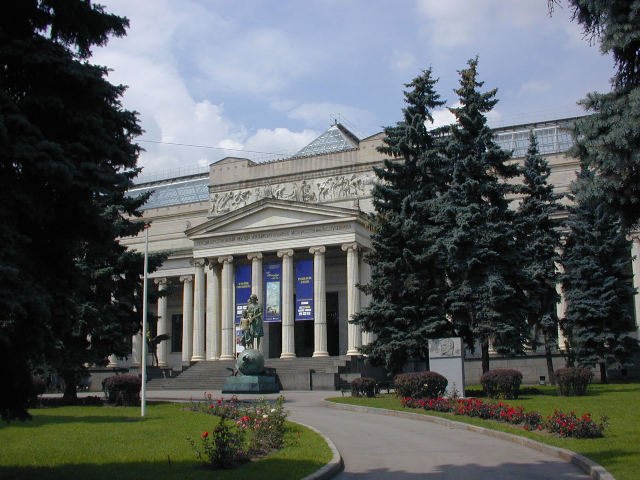
The teaching collection of plaster casts after antique and Renaissance sculpture — Tsvetaev’s idea, unmatched for completeness; the Fayum portraits; objects from Priam’s Treasure found by Schliemann at Troy; the Egyptian collection. The French 19th–20th century is in the Gallery at Volkhonka 14, on a separate ticket.
The Italian Court and the casts — the reason the museum was built. Then the Fayum portraits, the Egyptian hall and Priam’s Treasure.
Reference
Marina Tsvetaeva, “Father and His Museum” — how and why this collection of casts was built, written by the founder’s daughter.
| Mon | closed |
| Tue, Wed, Sun today | 10:00–20:00 |
| Thu, Sat | 10:00–21:00 |
| Fri | 11:00–21:00 |
Getting there — partly. Kropotkinskaya has no lift. The nearest drop-off is on Volkhonka. Moscow metro stations almost never have lifts to the platform, except on the Big Circle line and the MCC. A wheelchair user is better served by the surface buses, which are low-floor across the centre.
Over seven hundred objects: sculpture and painting of Russian Buddhism, almost none of it shown before. More than a hundred sculptures were conserved for the opening.
If the Fayum portraits are what drew you in, the Oriental Museum starts the same East from the other end: Central Asia, the Caucasus and Iran instead of Egypt.
If the casts left you thinking that the original matters more than the copy, everything in Lavrushinsky is original, and it shows what that costs.