Your browser is older than this page. The catalogue still reads here: the list, the filter and the cards all work. Your browser will mark filter choices with plain checkboxes, as best it can. Update your browser to see the page as it was built.
The Peter the Great Botanical Garden of the Faculty of Biology, Lomonosov Moscow State University — the Apothecary Garden
outstanding
A garden in the middle of the city: five hundred metres to the Garden Ring, and the ground is not large. Founded by Peter I in 1706. Moscow had several such physic gardens, and every one of them except this vanished without trace, while the larch here, planted by tradition by Peter himself (an increment borer confirms an age of only two hundred years — our note), is alive still, though since a lightning strike early in the twentieth century it has hardly grown. The Palm House of 1891 is the centre of a tropical collection gathered over more than two hundred years.
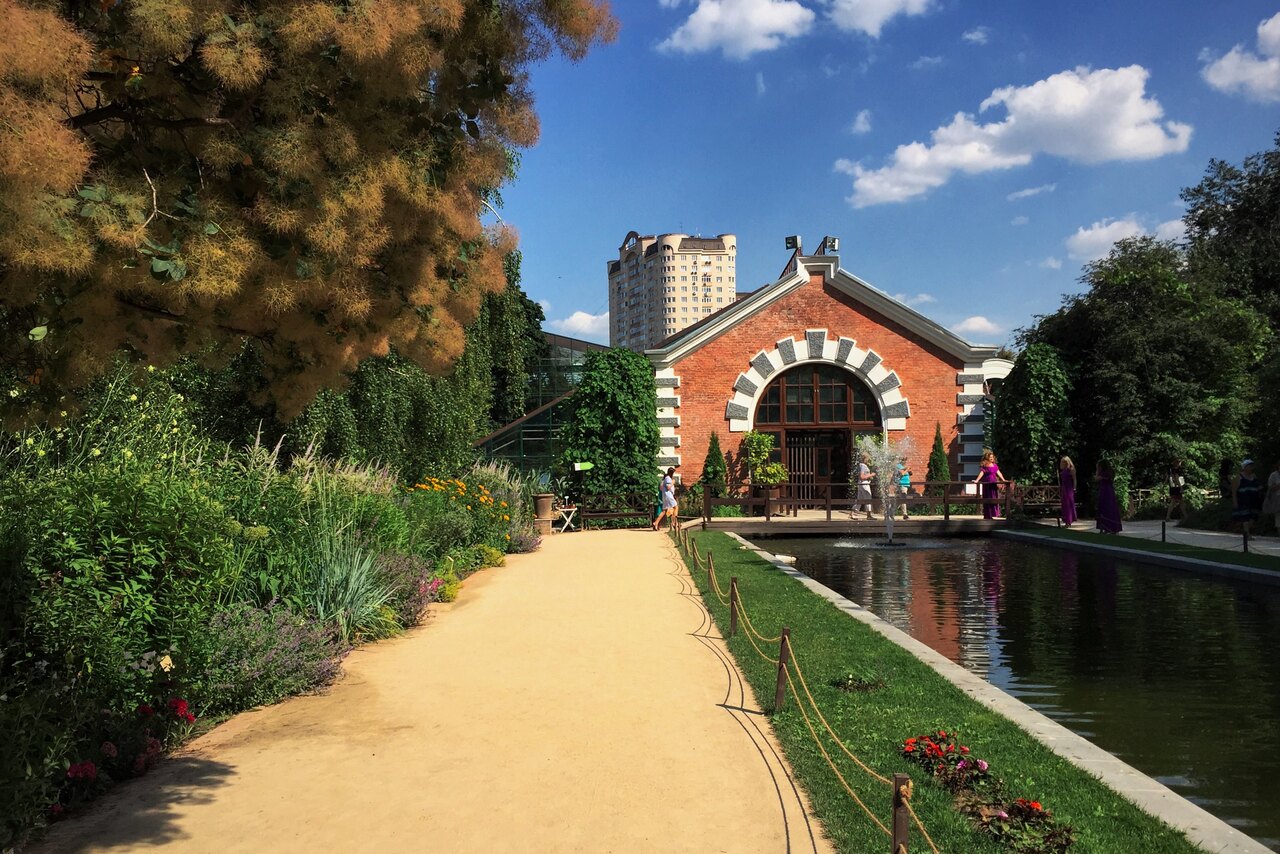
Peter's larch, as the garden has always called it, stands in the middle of the arboretum. Beside it a pedunculate oak more than two hundred years old, limes past a hundred, and a rare weeping form of the Dahurian larch. The Palm House of 1891: palms, figs and pandanus at their full height. The Succulent House on the upper floor of the glasshouse block holds cacti, euphorbias, agaves and aloes, some of them among the rarest anywhere. The old pond with its water plants, the shade garden, the heather slope where the rockery used to be; the conifer slopes took a gold diploma of the landscape architecture prize in 2013.
Minimum route — 1.5–2.5 hours; with the glasshouses about four for the essentials
30 minutes — the arboretum: Peter's larch, the oak, the limes, the heather and conifer slopes. 25 minutes — the Palm House. 20 minutes — the Succulent House upstairs. 15 minutes — the old pond and the shade garden.
Reference
About the museum
The garden was laid out in 1706 by decree of Peter I behind the Sukharev Tower, then on the northern edge of Moscow: medicinal herbs were grown here and future physicians taught. Its owners changed. The Apothecary Chancery, a hospital, the Medico-Surgical Academy — until in 1805 the land was bought by Moscow University, with which the garden remains to this day. The fire of 1812 burned out the glasshouses together with the library and the herbarium; only the trees deep in the park survived, and part of the ground had to be sold off for a nursery, the one occasion in three centuries when the garden grew smaller. Repin wrote in his diary that there were a great many people in the garden «despite the high entrance fee».
Getting in
Address
Prospekt Mira 26, building 1
How to get there
Metro Prospekt Mira, the Koltsevaya and Kaluzhsko-Rizhskaya lines, a few minutes on foot. Buses M2 and M9 from the centre to the Aptekarsky Ogorod stop. The main entrance is at Prospekt Mira 26, building 1.
Opening times
opens today at 10:00
Mon–Sun today
10:00–21:00
last admission 1 h before closing
The garden is open daily 10:00–21:00; the entrance and the box office work until 20:00, the glasshouses until 20:45. In summer, when it is above 25 degrees outside, the Succulent House opens only at 16:00. In winter the Subtropical House is kept at 12–14 degrees.
Tickets
Weekdays 500 ₽, weekends and holidays 600 ₽; concessions 350 and 400 ₽. A ticket with a guided tour is 1200 ₽; the annual pass is 7000 ₽ and is sold at the box office only. Children under seven, students and staff of Moscow University, people with first- and second-group disability together with a companion, and large families enter free.
from ₽500
tickets online
When to go
In summer heat the Succulent House opens only at 16:00: until that hour half the glasshouse route is shut. In winter the Subtropical House stands at 12–14 degrees, and standing there long is cold.
The Palm House and the pond need no explaining to a child. Children under seven enter free.
Access for visitors with limited mobility
The museum — not checked. Not checked. The garden names wheelchair users among those who enter free and writes nothing about the paths themselves. Getting there — not checked. Not checked.