Tata stands on water: karst springs rise within the town itself, the Öreg-tó lies in the middle of it, and mills stand along the streams. The baroque face of the place was made almost by one hand: Jakab Fellner built here for the Esterházys for forty years, and the palace, the churches and the old houses are his work. The list therefore rests on two supports, the Esterházys and the water, and half an hour’s walk takes you from one edge of the town to the other. What matters here is the building and the place: a castle on the water, a mill on a stream, a summer house in a garden, a hill sliced open by quarries in which tens of millions of years can be read.
Fifty-six artists and about a hundred works on what is left of the baroque in the art of today. The show belongs to the Tata Baroque Festival and occupies the summer house in the English Garden.
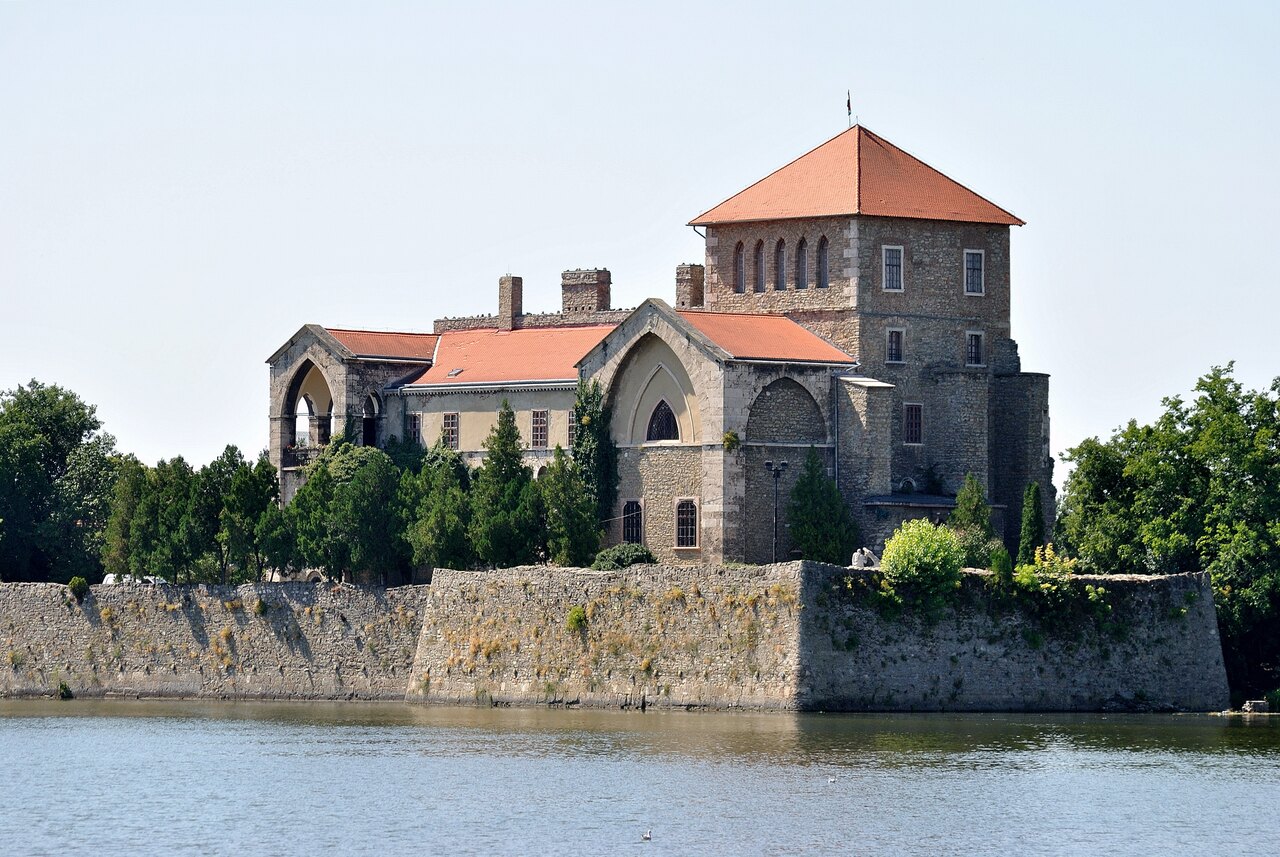
A castle standing in water, where Sigismund of Luxembourg held his court and received embassies and where Matthias Corvinus rebuilt the palace in the renaissance manner; the county museum has been in it since 1954. The collection grew out of the Piarists’ cabinet, begun in 1765 by Count Miklós Esterházy, and after Trianon it was left as the only scholarly collection on the stump of Komárom county: the county society had gone abroad together with Komárom. Hence the Roman material from Brigetio and Almásfüzitő, the carved stone of the Benedictine abbey of Vértesszentkereszt, and the faience for which the museum bears the name of Domokos Kuny. A sound provincial collection.
The green-glazed stove with knight figures — put back together from fragments out of a cellar filled in during the sixteenth century, and it carries the furnishing of the palace in the time of Matthias Corvinus. The Roman lapidary, opened in 1955 — stones from Brigetio and Almásfüzitő. The medieval lapidary — carving from the abbey of Vértesszentkereszt. The faience of Domokos Kuny (1754–1822). The Knights’ Hall of 1815, with the neo-Romanesque windows put in for the imperial manoeuvres of 1897. The standing displays A City Is Born and Everyday Life in the Middle Ages.
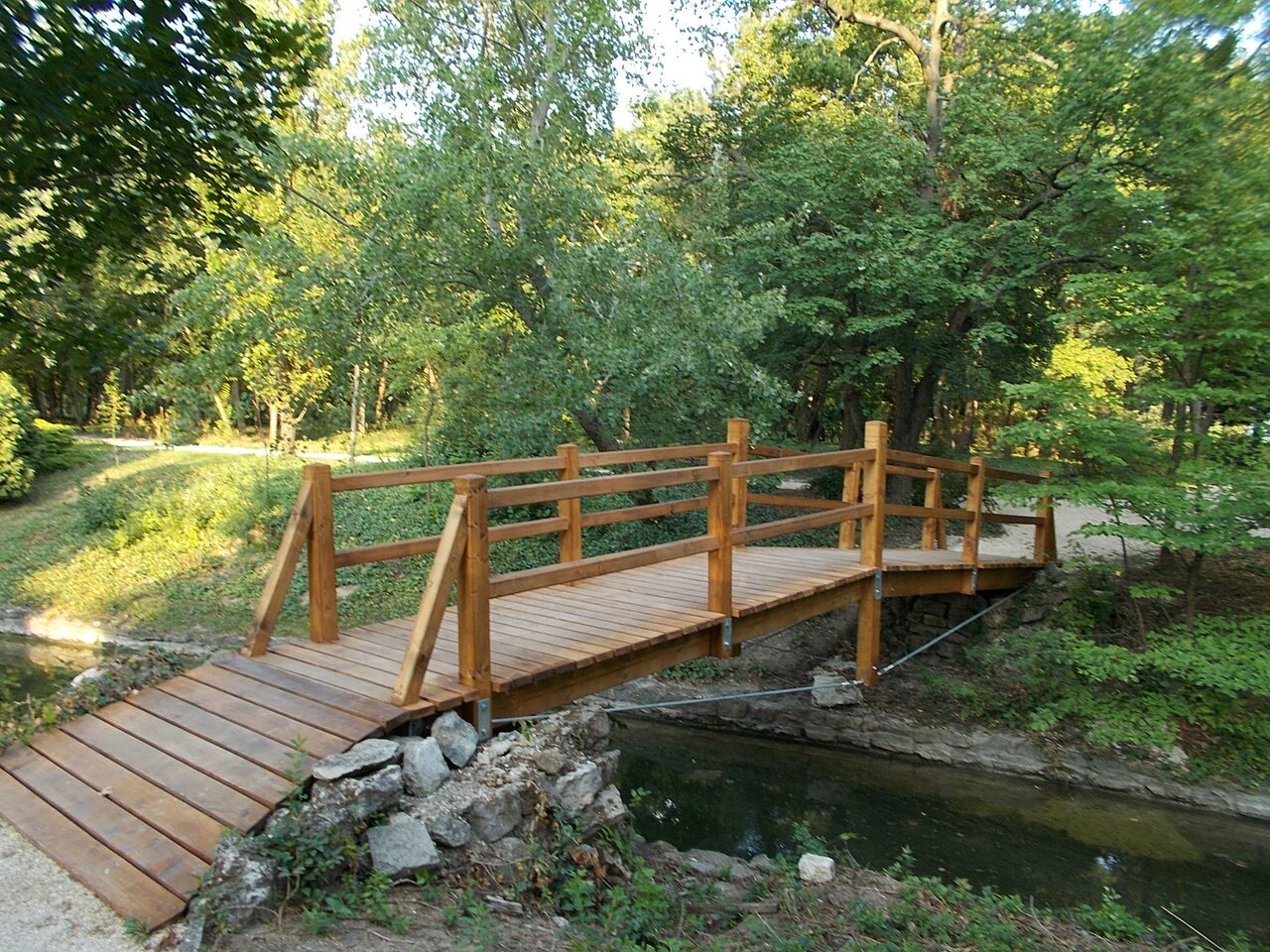
The garden was laid out in 1783 for the Esterházys by their engineer Ferenc Bőhm around the Cseke lake and counts as one of the oldest landscape parks in Hungary. In its northern part, in 1801, artificial ruins were built to a scheme by Charles de Moreau, and built of genuine stone: clustered columns and twenty-four carved capitals were carried off from the Romanesque Benedictine abbey of Vértesszentkereszt, and a Roman tombstone of the third century was set into a niche. A question follows, and it is worth putting to the reader plainly: a monument put together by taking other monuments apart — is that saving or plundering? There are other contrivances in the garden — a Turkish Mosque, two stone griffins at the entrance — and all of it is now being restored under the Esterházy Heritage project shared with Galanta.
The artificial ruins of 1801 to a scheme by Charles de Moreau: clustered columns and twenty-four carved capitals from the abbey of Vértesszentkereszt, a Roman tombstone of the third century from Látó Hill set in a niche, gravestones from Szőny. The Turkish Mosque and the stone griffins at the entrance. The garden of 1783 around the Cseke lake, laid out by Ferenc Bőhm. The Esterházy summer house stands in the same garden.
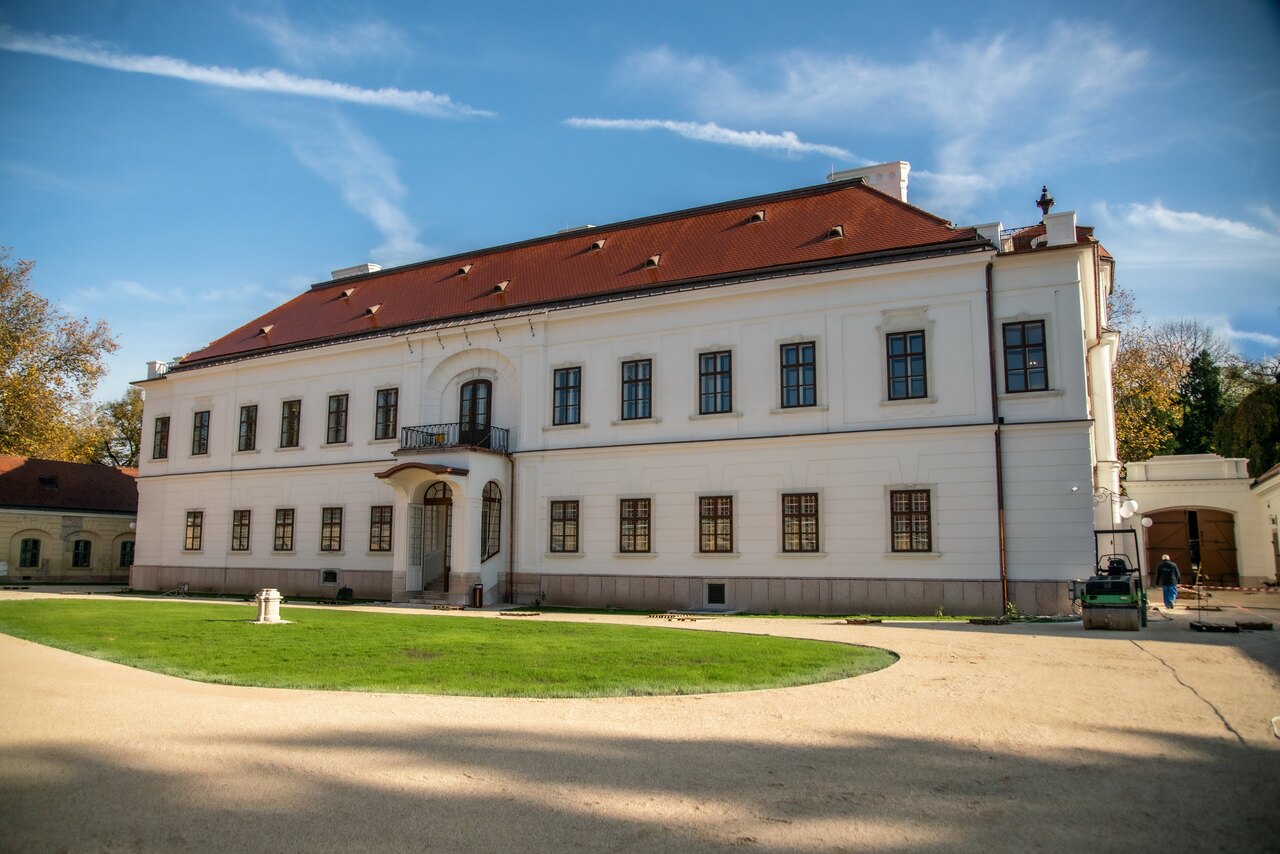
The palace of the counts Esterházy on the shore of the Öreg-tó. It owns nothing of its own — the furniture was plundered after March 1945 — and what stands there now only re-creates the old; the finish of the rooms, however, is original. Here, retreating before Napoleon, the emperor Francis I, who was Ferenc I as king of Hungary, lived for two months and signed the peace with the French on 14 October 1809. Here in 1897 Franz Joseph and Wilhelm II stayed together for the imperial manoeuvres, and from here on 2 May 1849 Görgei sent his troops to retake Buda. And here in 1921 Charles IV, the last king of Hungary, fled after his failed attempt to regain the throne: in this house he was taken into custody, and from it he went into exile. It was built by Jakab Fellner, court architect to the Esterházys, who built half of Tata. The Tata-Gesztes estate came to the family in 1727; the building was begun in 1763 by Count Miklós Esterházy, the Vienna court’s envoy to St Petersburg, and finished under his son Ferenc in the second half of the 1760s; the outside has stayed as it was ever since.
The dolls’ house of the counts’ daughters — a scale model of the palace itself, and beside it the sons’ lead soldiers, drawn up on an exact relief of the very imperial manoeuvres held at Tata. The great dining hall with restored wooden panelling and portraits of the family’s forebears; then the salon on those Esterházys who served in diplomacy. The library, the countess’s rooms, the count’s rooms on the ground floor. The tower room and the Tent Room — named after their wall painting; there too is a model of the palace theatre, and in the next room a short film about the musical past of the house: a standing orchestra was kept from 1806. All of it goes under the one name The Island of Peace (A béke szigete).
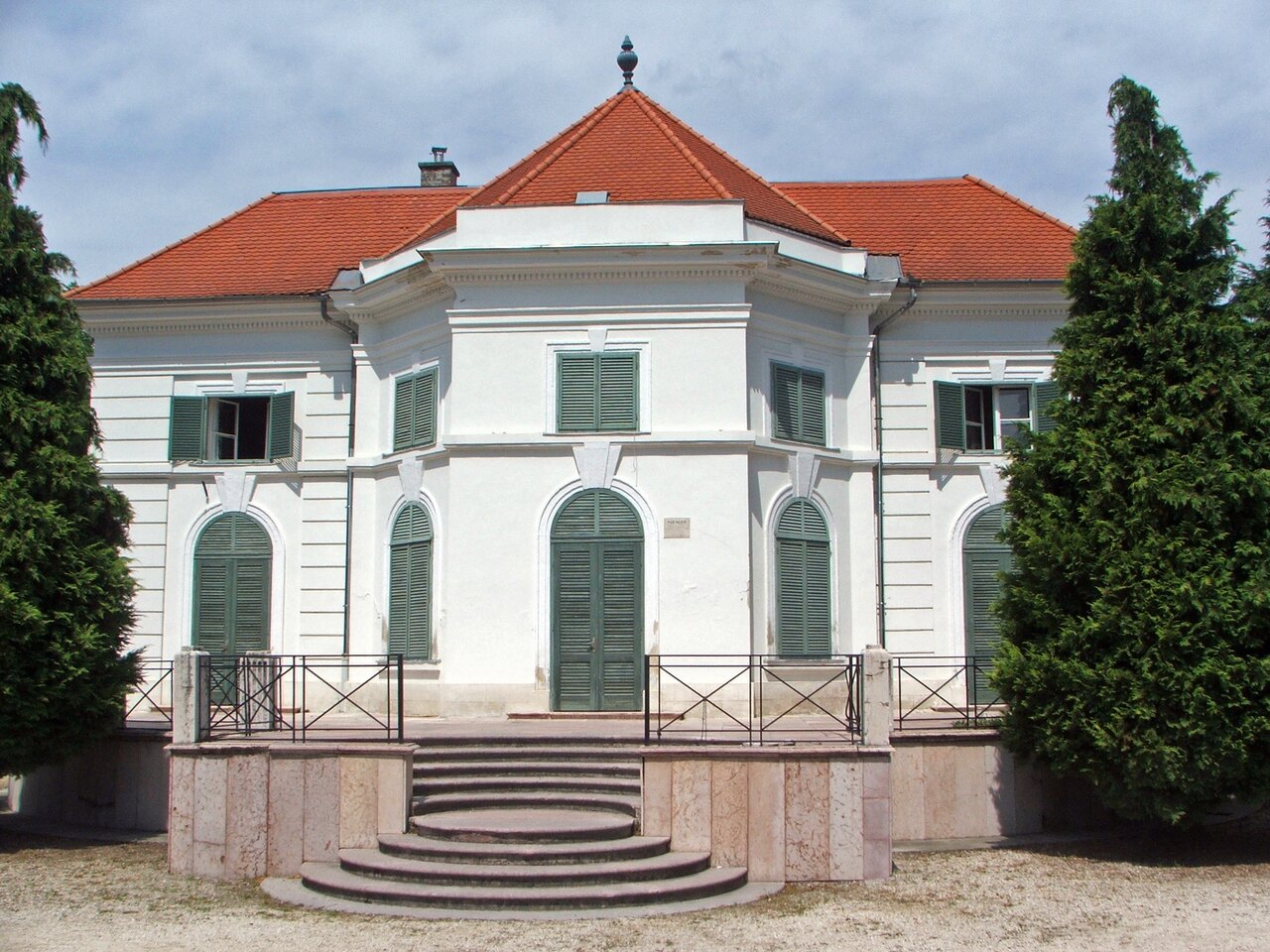
The small Esterházy house in the English Garden — the oldest building in the park, put up by József Grossmann in 1784 in the Zopf manner; it was made for seclusion, with nothing of display about it. On the ground floor the original decorative painting has been brought back — a reception room with a landscape over the walls, and linear painting in the other rooms. Upstairs an exhibition, The Garden, has opened, in which the English Garden is shown from four sides: as a stage and as a landscape, as a people’s park and as a collection.
The original decorative painting of the ground floor: the reception room with a landscape over its walls and the linear painting of the other rooms — the thing for which the house was restored at all. The exhibition The Garden (A kert, 2026) on the upper floor — the garden as a stage, as a landscape, as a people’s park and as a collection; curated by Máté Stegmayer, Mónika Kövesdi, Zsófia Szegleti and József Szűcs. The ground-floor rooms: the reception room, the ladies’ salon, the master’s study. The building itself, of 1784, by József Grossmann.
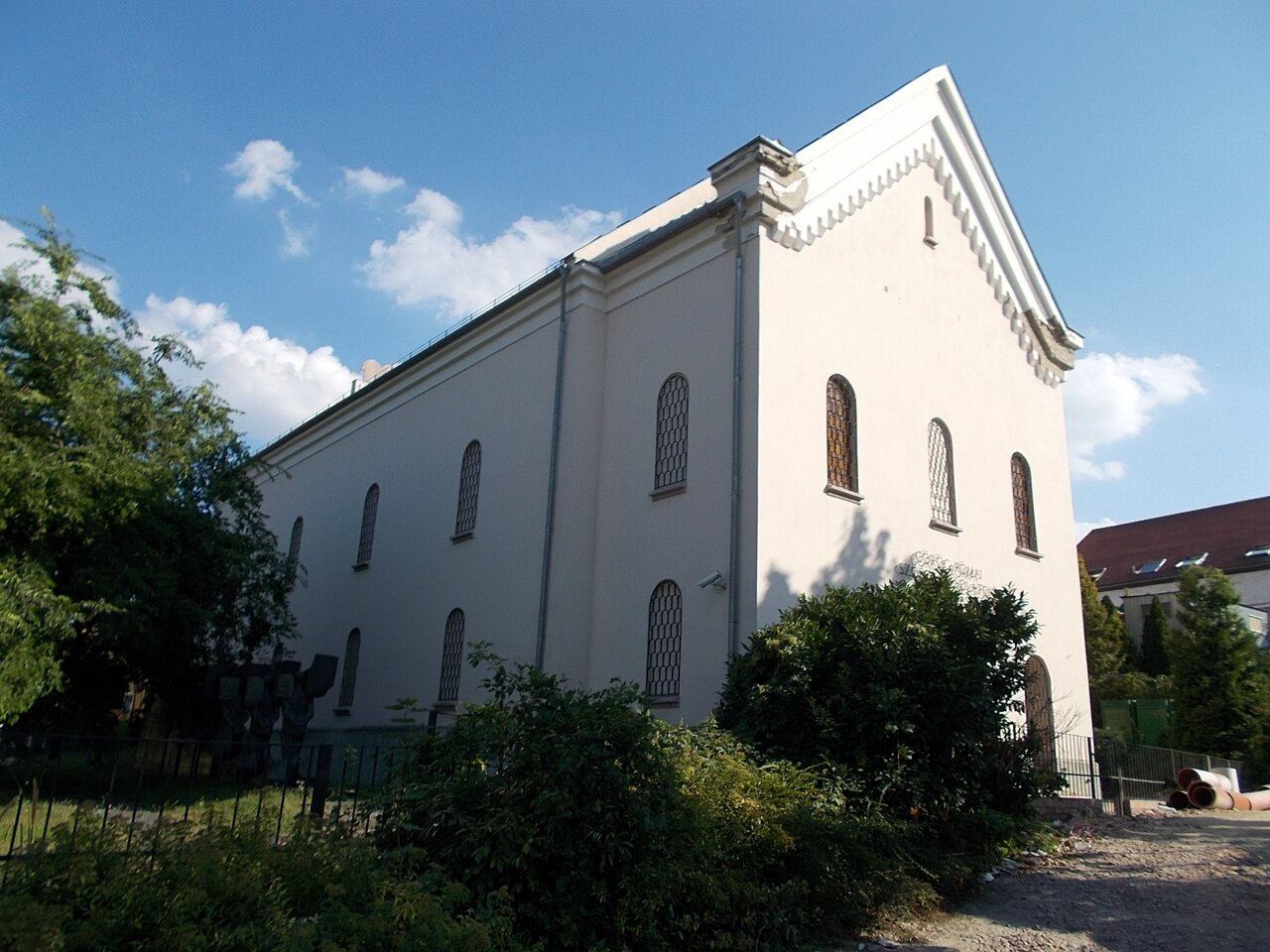
A synagogue rebuilt in 1861 in the romantic manner to the design of Ignác Wechselmann. There is no standing display in the house at all. What remains is the building itself and the memory of a community the town no longer has; in the garden stands a monument to the victims of the Holocaust by Mária Lugossy, unveiled on 18 November 2004.
The building itself — the rebuilding of 1861 to the design of Ignác Wechselmann (1828–1903). In the garden, the memorial place of Komárom-Esztergom county and the sculptural group by Mária Lugossy, In Memory of the Martyrs of All Times, of 2004. There is no standing display; the hall is given to temporary ones.
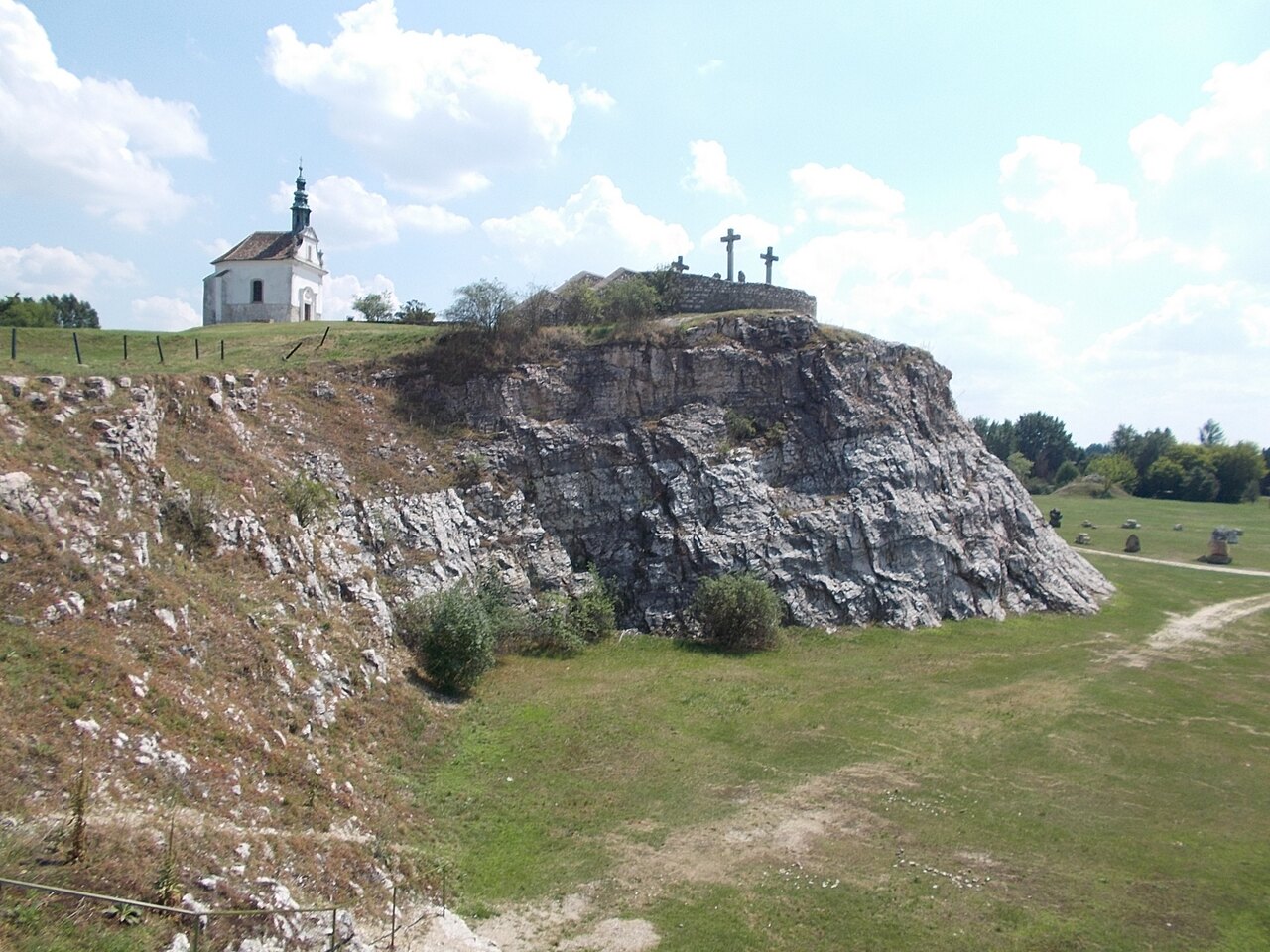
Kálvária Hill, cut away by quarries, reads like an open book: the rock faces have been cleared on purpose, for science, so that tens of millions of years of the earth’s history run along them. The place has been protected since 1953 and since 1958 has counted as a nature monument of national standing. One may only go round with a guide: without explanation a rock face stays a rock. Stone has been taken from this hill for five thousand years — the traces of Copper Age flint working are still on it.
The cleared rock faces — stones of a kind no longer formed today, and phenomena that a textbook can only draw as a diagram. The stone park — the commonest rock-forming stones of Hungary, gathered into one walk. The traces of Copper Age flint working. On the top of the hill a baroque chapel and a calvary, and beside them a lookout tower, the Söréttorony.
Germans have lived in these parts since the early Middle Ages, settled here in great waves in the eighteenth century, and in 1946 were carried off by train; there is no second museum of that community in the country. The main thing here is not ethnography: the standing display of 2015, We and the Others, works out how a majority forms its notion of a minority — a rare case of a minority museum taking on the mechanism itself. ICOM Hungary gave it its award for that in 2023.
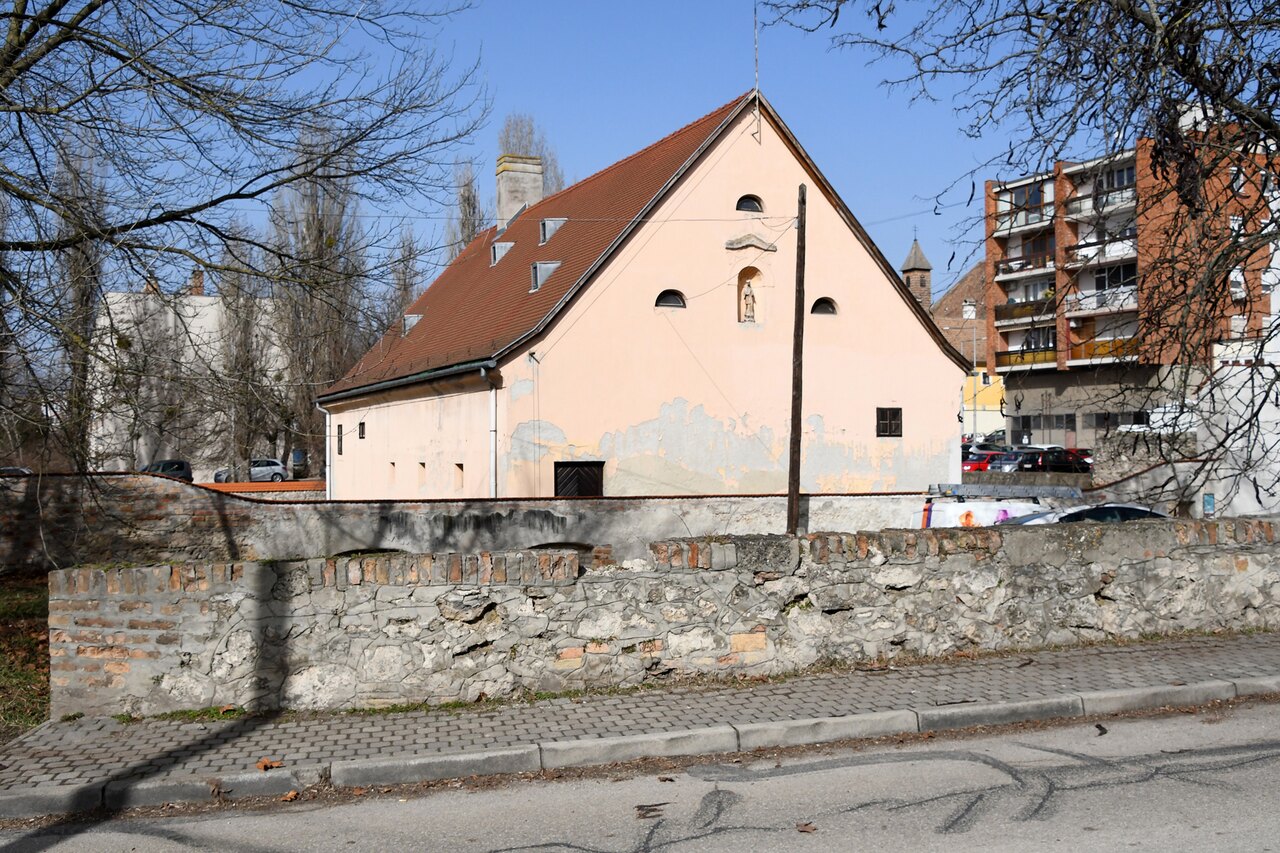
The standing display We and the Others (Mi és a többiek, 2015): the Histories section — a thousand years of the state’s dealings with its minorities, laid out as a river with its shoals and dams — and facing it the personal keepsakes given to the museum by people and communities; the Objects section — what has counted at various times as a typically German thing. The Nepomuk mill of 1758 by Jakab Fellner: how the mill was built and how it worked is shown on the ground floor. The wooden statue of John of Nepomuk on the front. An open store in the former granary. Of the costume and household gear one expects from a local museum there is less here than there is talk.
Alkotmány utca 1 ··
· No. 93
Our rating scale
The rating here is our own — the judgement of those who compile this catalogue. It speaks of what a museum is worth coming for: where there is a collection, of the collection; where there is none, of the building, the ensemble or the monument and of what is shown in their rooms. Neither a queue in the street nor a loud name enters into it.
world-class
In the same rank as the world's leading museums.
outstanding
Worth a visit made for its own sake.
significant
There is something here worth coming for.
for enthusiasts
It answers those who come for the subject itself.
niche
Valued by a narrow circle and unrecognised beyond it.
A distinction apart
underrated
Worth more than its reputation: fewer people know it than it deserves
one of a kind
There is no counterpart — not in the country, not anywhere
read first
Without reading beforehand it reads as ornament; with it, the whole thing opens
quiet here
No crowds: you can look at your own pace and on your own
How we keep this list
Checked on 19 August 2026 — against museum sites and open sources. Each entry carries its own date and its own note of what it was checked against. A price we could not confirm we mark as unconfirmed; the previous one does not stay in the entry.
How long — for the most important things, along our minimum route. The café, the shop and the queue at the cloakroom are not counted. Going round the whole museum almost always takes longer.
The photographs are taken from Wikimedia Commons under free licences; the author and the licence stand under each.
18 May — International Museum Day, kept since 1977; on the night of 17 to 18 May, the Night of Museums. On those days museums keep a special timetable and admission is often free.
If we got it wrong
Every figure and date on these pages has been checked by us. Write to us if a museum has changed its hours or its prices, if a link has died, or if a museum is missing from the list. We will correct it and set a new date of checking.