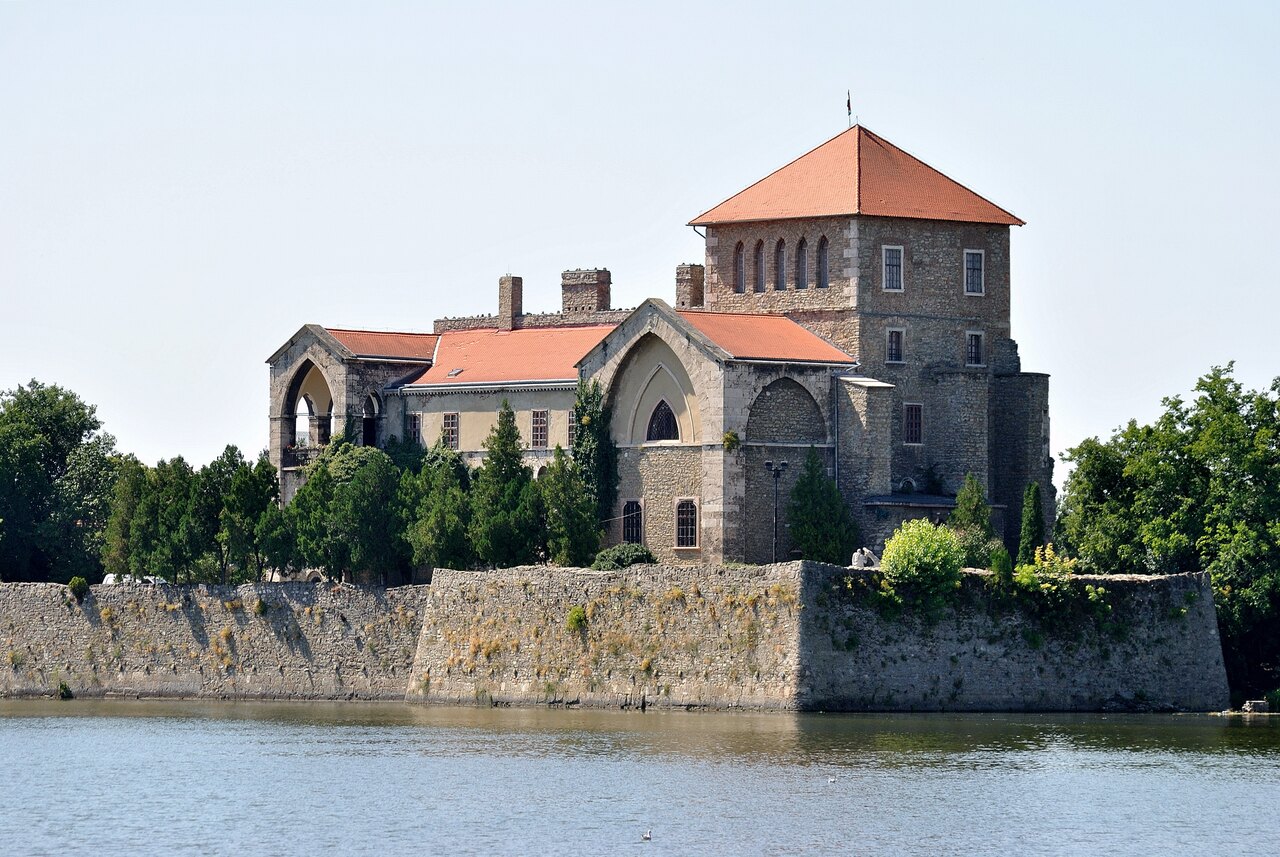
A castle standing in water, where Sigismund of Luxembourg held his court and received embassies and where Matthias Corvinus rebuilt the palace in the renaissance manner; the county museum has been in it since 1954. The collection grew out of the Piarists’ cabinet, begun in 1765 by Count Miklós Esterházy, and after Trianon it was left as the only scholarly collection on the stump of Komárom county: the county society had gone abroad together with Komárom. Hence the Roman material from Brigetio and Almásfüzitő, the carved stone of the Benedictine abbey of Vértesszentkereszt, and the faience for which the museum bears the name of Domokos Kuny. A sound provincial collection.
The green-glazed stove with knight figures — put back together from fragments out of a cellar filled in during the sixteenth century, and it carries the furnishing of the palace in the time of Matthias Corvinus. The Roman lapidary, opened in 1955 — stones from Brigetio and Almásfüzitő. The medieval lapidary — carving from the abbey of Vértesszentkereszt. The faience of Domokos Kuny (1754–1822). The Knights’ Hall of 1815, with the neo-Romanesque windows put in for the imperial manoeuvres of 1897. The standing displays A City Is Born and Everyday Life in the Middle Ages.
Minimum route — 1–1.5 hours for the essentials
An hour and a quarter.
20 minutesthe green-glazed stove with its knight figures and the halls of medieval Tata.
20 minutesthe Roman lapidary: stones from Brigetio and Almásfüzitő.
15 minutesthe medieval lapidary with the carving from Vértesszentkereszt.
10 minutesthe faience of Domokos Kuny.
10 minutesthe Knights’ Hall and the lake seen from its windows.
Reference
About the museum
The Piarists began their collection in 1765; it became the town museum in 1912 and moved into the castle in 1954, taking the name of Domokos Kuny. The Roman lapidary opened in 1955, and the paintings from the Esterházy houses at Tata and Majk came in at the same time. The excavation and restoration of the building ran from 1964 to 1973.
The building
The castle carries the marks of six centuries. The first royal palace under Sigismund was ready by 1409; Matthias Corvinus added terraces, a cloister walk and a gate tower. After Mohács it became a frontier stronghold: the round bastion was finished in 1543, the Ferrando bastion in 1572, the Goat bastion with its underground casemates and gun chamber in 1586. The Knights’ Hall was made out of the open gallery in 1815, and its neo-Romanesque windows were put in for the imperial manoeuvres of 1897.
What to read
Éva Fülöp and Julianna Kisné Cseh, “A tatai múzeum története 1912–2002” — the history of the collection itself, written by its keepers. Tata, 2002.
ISBN 9637110372
Getting in
Addresschecked on 19 August 2026, the museum website
Váralja utca 1–3
How to get there
The castle stands on the north-west shore of the Öreg-tó, ten minutes on foot from Tata station.
Opening timeschecked on 19 August 2026, the museum website
closed for the day
Mon
closed
Tue–Sun today
09:00–17:00
Closed on Mondays.
Ticketschecked on 19 August 2026, the museum website
Adults 3,000 Ft, reduced 1,500 Ft. Groups of ten or more 2,000 Ft. Family tickets from 2,250 to 4,500 Ft, the fifth child free. A joint ticket with the Museum of the Hungarian Germans costs 3,500 Ft. The casemate tour is 2,000 Ft on top.
from HUF 3,000
When to go
The castle stands in the water, and the best view of it is from the south shore of the lake in the morning, when the sun falls full on the walls. The casemate tour needs a separate ticket and does not run every day.
A castle with towers and underground casemates usually appeals to children, though the labels in the halls are in Hungarian only. The stove and the weapons hold attention; the lapidaries do not.
If this moved you
In the same city
The medieval lapidary holds carving from the abbey of Vértesszentkereszt; twenty-four capitals from the same abbey are built into the artificial ruins of the English Garden.