Moscow museums · Science and nature
Science and nature · since 1716
The Mineralogical Museum
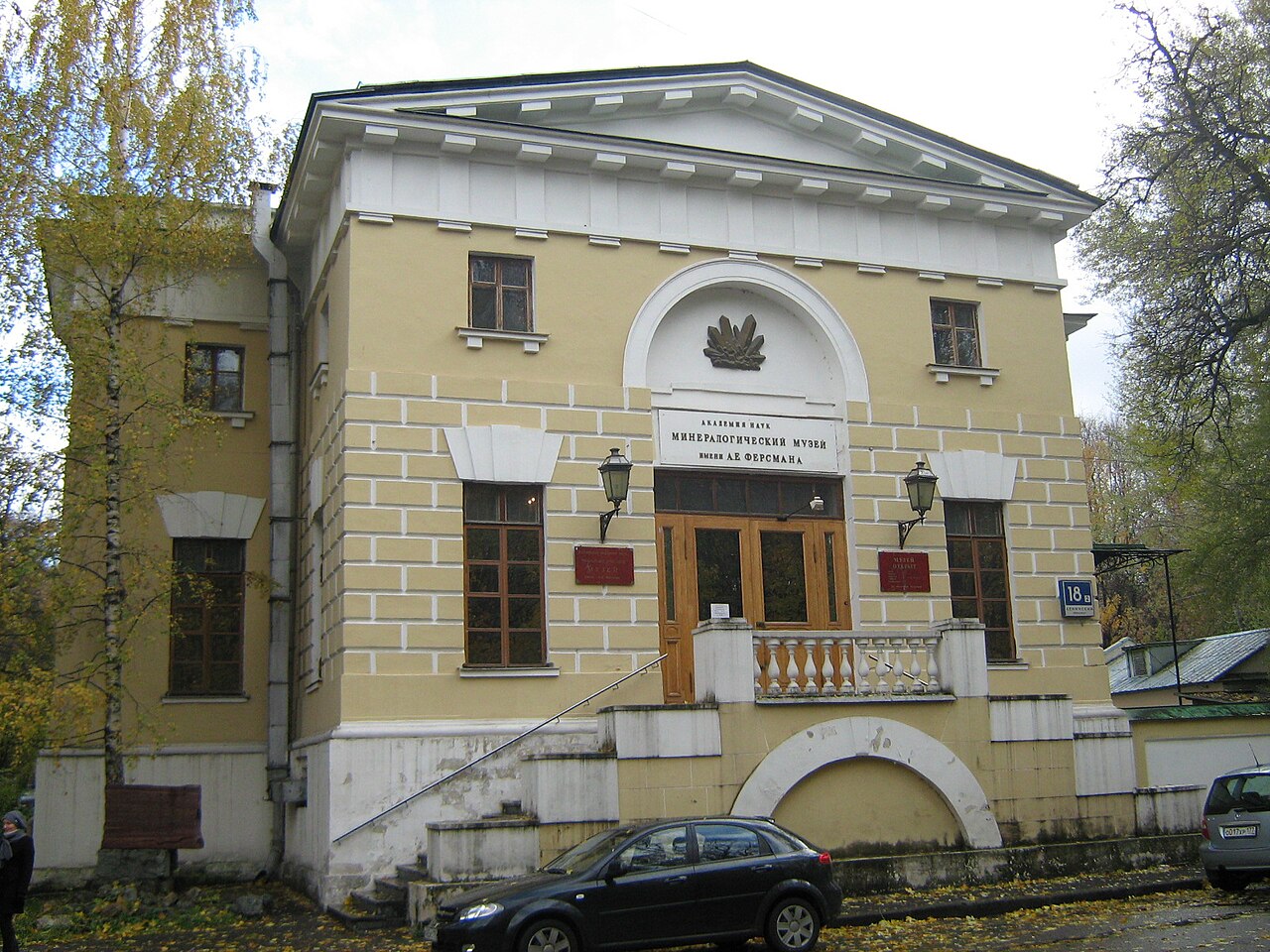
The Fersman Mineralogical Museum
A collection more than three hundred years old: it grew out of the mineral cabinet of Peter’s Kunstkamera and moved to Moscow with the Academy of Sciences. Some hundred and forty thousand specimens make it one of the largest mineralogical museums in the world, and for the systematics of stone it has no equal in Russia. The Vault at South Kensington shows a few dozen chosen stones magnificently; the point here is the opposite — the whole class, in order, with the ordinary specimen beside the extraordinary one, which is what a systematic collection is for. Come knowing that this is a scientific museum and not an entertaining one: cases, labels, no screens. Anyone who wants the telling needs a guided tour, and it must be booked ahead.
Minimum route
1–1.5 hours
Founded
1716
Ticket
from ₽500
Today
11:00–18:00
What to see
The systematic collection — the whole known mineral world by class. Ural malachite and rhodonite from the old crown holdings. Meteorites. Hardstone work by Fabergé and the Peterhof lapidary works. Large specimens of a size only museums of this age possess.
Minimum route — 1–1.5 hours for the essentials
An hour.
- 25 minutesthe systematic collection: walk it through without trying to read everything.
- 20 minutesthe hall of deposits and Ural stone.
- 15 minutesthe cases of worked pieces and the meteorites.
Reference
About the museum
Descended from the Mineral Cabinet of the Kunstkamera, founded in 1716; it moved to Moscow with the Academy of Sciences in 1934 and took the riding house of the Demidov-Orlov estate in the Neskuchny Garden.
The building
An eighteenth-century riding house from the Neskuchny Garden estate: a long hall with light from above, adapted for a museum but not made over. The room itself is part of the impression.
Good to know
The museum is academic and it shows in everything: the labels are written for specialists and there is no interactive. A kiosk at the museum sells specimens — a rarity for a state museum.
What to read
Peter Bancroft, “Gem & Crystal Treasures” — the standard survey of the world’s great mineral specimens, in which this museum takes its place among the half-dozen that matter. Fallbrook: Western Enterprises, 1984.
ISBN 9780961346119
Getting in
How to get there
From metro Oktyabrskaya, Leninsky Prospekt or Ploshchad Gagarina (MCC) by bus or trolleybus M1, m16, 297 to the stop Bolnitsa Svyatitelya Aleksiya.
Opening timeschecked on 16 August 2026, the museum website
closed for the day
| Mon, Tue | closed |
| Wed–Sun today | 11:00–18:00 |
Closed Mondays and Tuesdays. Guided tours by prior booking only.
Tickets
Adults 500 ₽; family ticket (two adults and one to three children) 1000 ₽; pensioners, schoolchildren, students, conscripts and disabled visitors 250 ₽.
from ₽500
When to go
A sunny day. The lighting in the halls is even, but stone opens in direct light, and by the windows this can be seen. There are never crowds.
Contacts
Of interest to children
Stones interest children by themselves: colour, lustre, crystals. From 7, but an adult will have to do the explaining — the museum does not.
· No. 63