Kuskovo
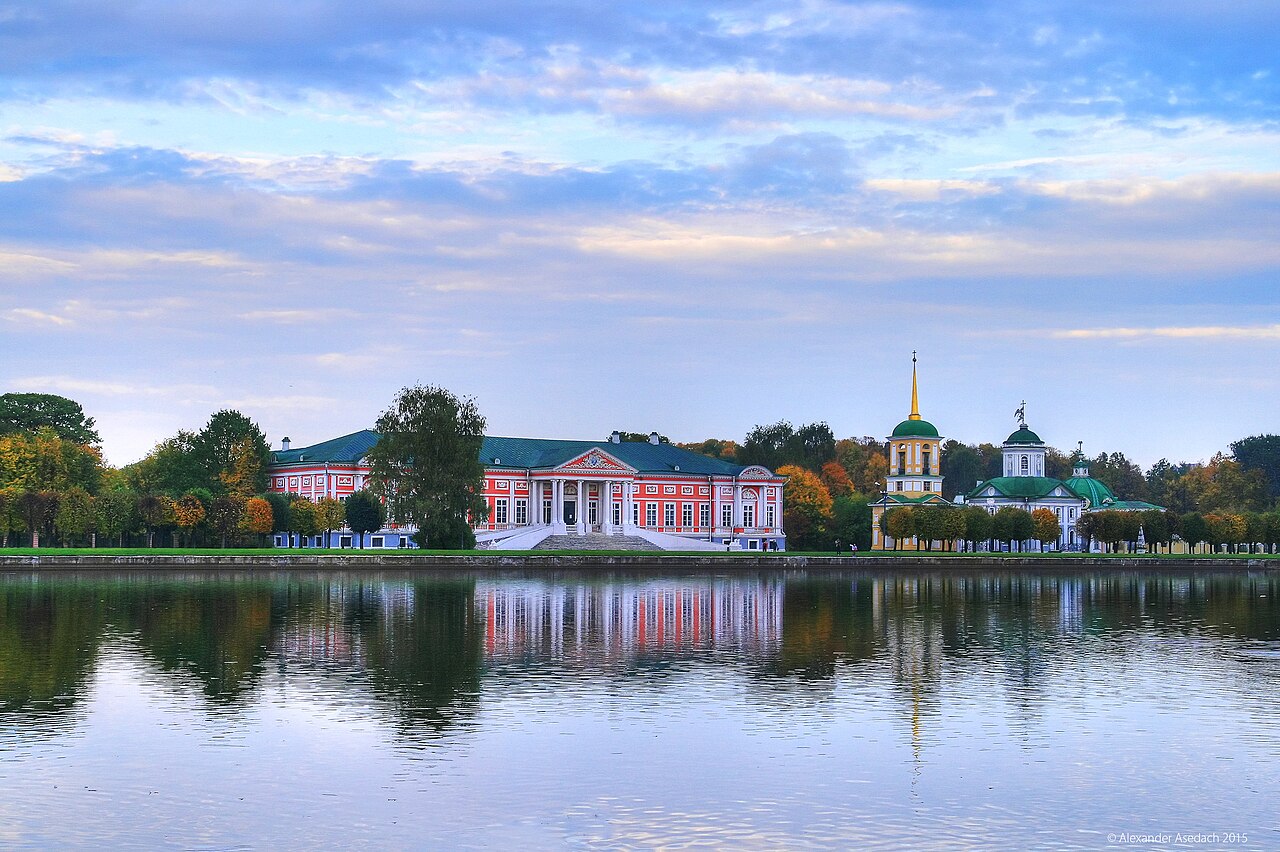
The wooden palace of 1769–1775 with its interiors and inlaid parquet intact. The Grotto with its shell-work — a thing that exists nowhere else in Russia. The Dutch and Italian houses, the Hermitage, the orangery. A collection of porcelain from Meissen to Soviet agitprop.
Three hours.
- 50 minutesthe palace: the enfilade, the ballroom, the state bedchamber.
- 25 minutesthe Grotto, for the shell-work.
- 30 minutesthe Dutch and Italian houses.
- 45 minutesthe Museum of Ceramics in the Great Stone Orangery.
- 30 minutesthe formal park, without which the estate cannot be read.
Reference
Priscilla Roosevelt, “Life on the Russian Country Estate: A Social and Cultural History” — after it the enfilade reads as a timetable of the day rather than a row of rooms. New Haven: Yale University Press, 1995.
| Mon, Tue today | closed |
| Wed–Sun | 10:00–18:00 |
For the seventy-fifth year of Viktor Neplyuev, chief artist of the Gzhel works from 1984 to 1989. Small genre figures in series: porcelain with underglaze painting, made by a man who knows the limits of the craft from inside.
Allegory as the language of the eighteenth century: what the figures meant that Pyotr Borisovich Sheremetev ordered for the palace and the park. A small show in the Portrait Room, and the key to what stands along the avenues at Kuskovo.
Praskovya Kovalyova-Zhemchugova: daughter of a serf blacksmith, singer of the Sheremetev theatre, later the wife of Nikolai Petrovich Sheremetev. Portraits of different years and things from her rooms; a summer show in the palace.
Danish porcelain from the last quarter of the eighteenth century to the second half of the twentieth — a monographic project the museum has never attempted before. The core was gathered by the Museum of Ceramics from the 1920s, when the things of Maria Fyodorovna, the Danish princess Dagmar, were handed over from the Armoury. In the Great Stone Orangery.
The plant world of the estate in the second half of the eighteenth and the early nineteenth century: what the Kuskovo orangeries and parks were proud of under Pyotr Borisovich and Nikolai Petrovich Sheremetev. Beside it, drawings and applied art of a time when artists took botanical atlases for their model. In the loggia of the Italian House.