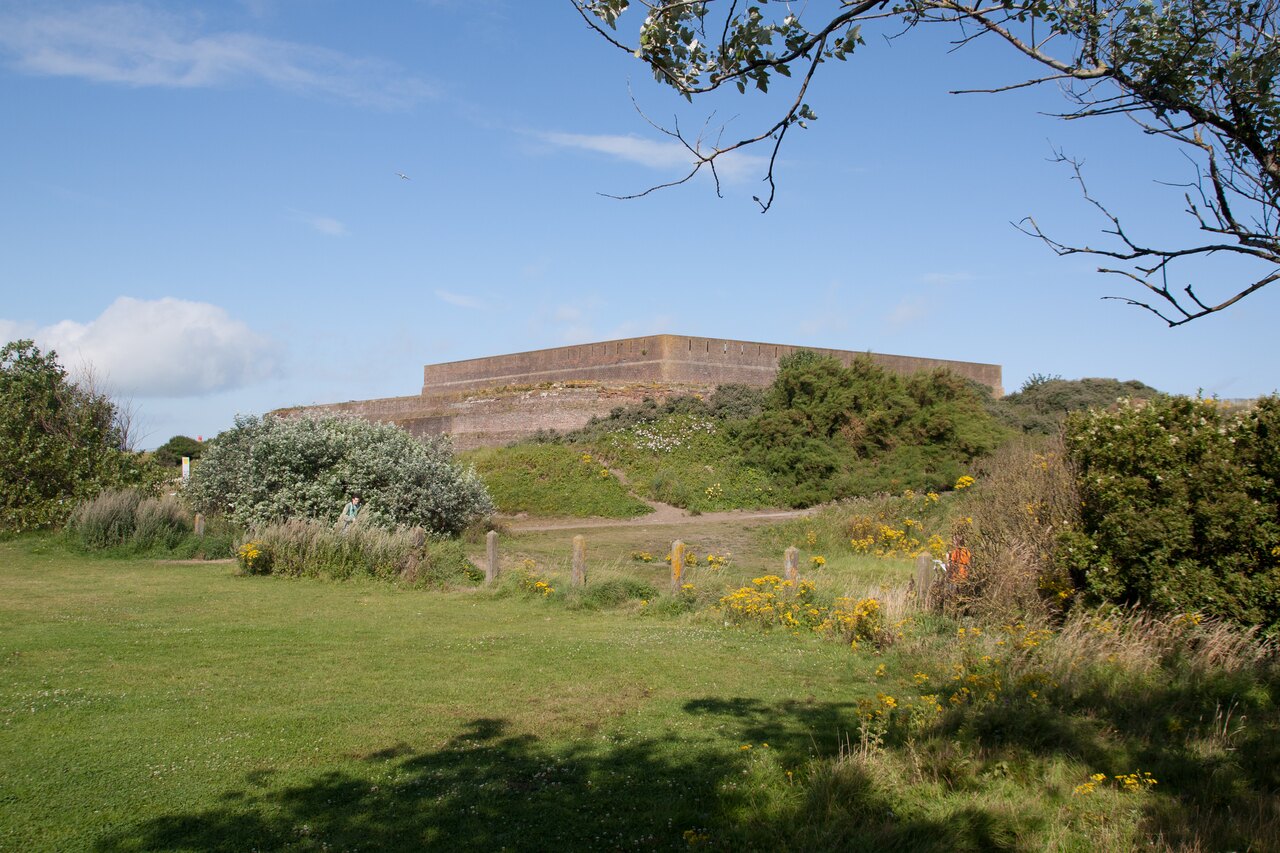
A five-sided tower fort of 1811, of the tours et redoutes modèle 1811 type: five walls of 27.4 metres, brickwork 2.65 metres thick, more than eight million bricks, the foundation pit dug by Spanish prisoners of war and conscripted local builders. The fort saw neither siege nor action: Napoleon’s star set before it was needed, and so it came through whole. It did not stand empty, though. In the First World War the Germans made it the artillery’s assembly quarters, put the Hindenburg battery behind it and brought in electricity, heating and water; in the Second the fort was taken into the Atlantic Wall. From that first occupation the murals of 1915 remain on its walls, and they are the one thing here that can be called a collection. What is shown now is a story route and temporary exhibitions.
The mural Der Barbar of 1915 by the soldier-artist Heinrich-Otto Pieper (1881–1968), over the chimneypiece: a German knight in armour with his broadsword at a Scot’s throat, and beside him the severed heads of an Italian, a Frenchman, a Japanese, a Senegalese and a Russian — German war propaganda without a fig leaf; next to it an allegorical version of the Bremen Town Musicians. Restored in 1932. The building itself: a pentagon with its north corner to the sea, two tiers of casemates, a dormitory for five hundred soldiers with 96 loopholes, a dry moat ten metres wide and five caponiers.
Minimum route — about an hour for the essentials
An hour.
15 minutesthe inner courtyard and the brickwork of the pentagon from outside.
25 minutesthe lower casemates with the Der Barbar mural over the chimneypiece.
15 minutesthe upper floor, the dormitory for five hundred with its loopholes.
5 minutesthe roof, with the harbour and the sea in view.
Reference
About the museum
The fort was finished early in 1814, when there was no longer anyone to fight; the French withdrew on 13 April of that year. It went on changing names with the powers — Impérial, Souverein, William, Leopold — and became Napoleon in 1830. The fort and the dunes around it were listed on 6 July 1976; it is now run by the Herita foundation with the city and the province.
Good to know
The museumPASSmusées is not valid here: the fort is run by Herita and stands outside that network. Entry is by timed slot, and at weekends and in the holidays the slots go early. The lower gallery is unheated and in winter holds the same temperature as outdoors.
Getting in
Addresschecked on 19 August 2026, the museum website
Vuurtorenweg 13
How to get there
The fort stands in the dunes on the east bank of the harbour. A free ferry crosses the channel from the centre, and it is a quarter of an hour on foot from the landing.
Opening timeschecked on 19 August 2026, the museum website
closed for the day
Mon
closed
Tue–Sun today
10:00–18:00
last admission 1 h 15 min before closing
From 1 April to 11 November until 18:00, last admission 16:45; from 12 November to 31 March until 17:00, last admission 15:45. Closed on Mondays except public holidays and Flemish school holidays.
Ticketschecked on 19 August 2026, the museum website
Adults €11. Children 6–12 €9, under 6 free. Groups of ten or more €9. During temporary exhibitions the price may differ.
from €11
tickets online · timed entry
When to go
Book ahead: the number of visitors per slot is limited and at weekends the slots run out. In winter the lower gallery is as cold as the street, so dress for outdoors.
Children must be accompanied by an adult; the fort requires it. The stairs are narrow and the galleries dark, and a child either takes to it entirely or finds it a little frightening.
Graffiti before it became street art: a route through the dark fort after an invented writer, a metro carriage under tags, and a wall the visitors write on themselves.
If this moved you
In the same city
The fort was written into the Atlantic Wall in 1940; the wall itself survives six kilometres to the west, and there one sees what the thing this fort began turned into.