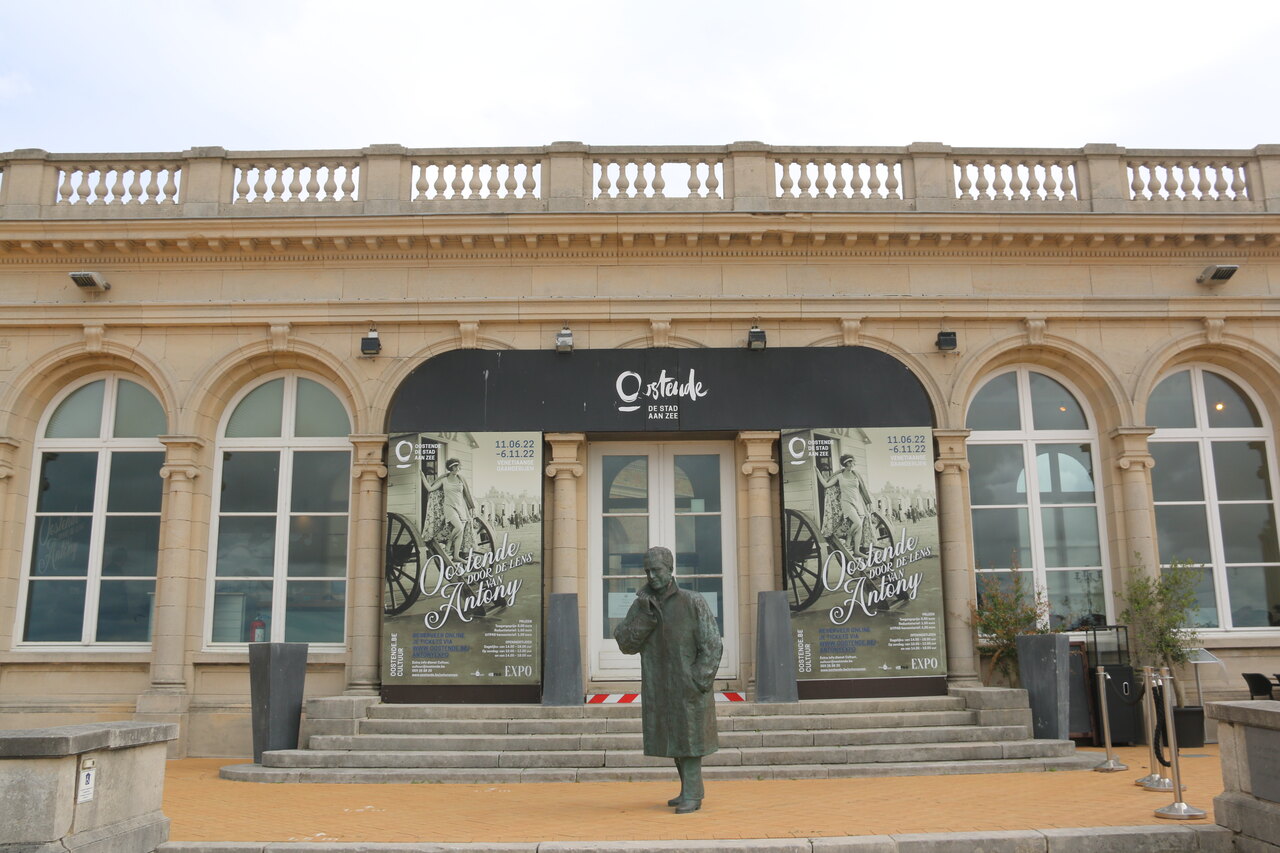
The only collection arranged as one continuous account of art in Belgium: eight thousand works by 1,341 artists, from François Bossuet of 1821 to Luc Tuymans; the museum puts it as “from 1880 to tomorrow”. There is more Spilliaert here than anywhere in the world — a hundred and ten works of its own plus a private collection on long loan since 2020, and that is what people come for.
The museum’s own building on Romestraat has been closed for rebuilding since January 2025 and reopens in 2028; the collection is shown in parts in the Venetian Galleries, so the whole of it cannot be seen at present. The Léon Spilliaert holding — the Ostend seafront and dyke, the night self-portraits; nothing matches it anywhere, and at its core stands Self-portrait with Red Pencil of 1908, Indian ink, gouache and pastel on paper, 85 × 69 cm, inv. SM000005. James Ensor and the circle of Les XX (Willy Finch). Constant Permeke, Jean Brusselmans, Frits Van den Berghe — Flemish expressionism. Paul Delvaux, Georges Vantongerloo, Roger Raveel, Luc Tuymans. The oldest work is François Bossuet’s The Sawmills at Slijkens near Ostend, 1821.
Minimum route — 1–1.5 hours for the essentials
An hour.
10 minutesthe gallery itself: the long covered walk along Parijsstraat and the great salon set at an angle where the two arms meet.
25 minutesthe thematic exhibition, which takes the gallery entire.
15 minutesthe great hall, where the focus each time is one work, one artist, one archive or one ensemble.
10 minutesthe working store at the back of the great hall: you see how a museum works, not only what it shows. A three-year experiment with light runs there too — the museum is watching how light falls on its own works, and will hang by what it learns after 2028.
Reference
About the museum
The museum was formed in 2008 by merging two Ostend collections — the municipal Museum of Fine Arts and the provincial Museum of Modern Art (PMMK); the association was constituted in 2010, and since 2018 the museum has been run jointly by the Flemish Community and the city. The name reads as “museum by the sea”. Two more houses come under it outside Ostend: the Permeke Museum in Jabbeke and the Peiremuzee in Knokke-Heist.
The building
The house at Romestraat 11 was built in 1949–1955 to a 1948 design by Gaston Eysselinck as the department store of the S.E.O. workers’ cooperative: a concrete frame, a facing of polished Swedish granite, thirty metres of curved glass along the front. It served as a store for a quarter of a century; the cooperative went bankrupt in 1981 and in 1982 the building passed to the province for a museum. The Venetian Galleries, where the museum now sits, are a covered gallery of 1900–1903 by Henri Maquet, built at the wish of Leopold II.
Good to know
Nobody is showing the whole of this collection at the moment. The museum’s own building at Romestraat 11 closed in January 2025 and reopens in 2028; for that time the museum has taken the Venetian Galleries, and part of the collection has gone out to other halls — Amsterdam, Antwerp, Drogenbos, Koksijde — and to its own houses in Jabbeke and Knokke-Heist. Four successive exhibitions will run in the galleries over the three years, each taking the whole space.
What to read
Anne Adriaens-Pannier has been compiling the Spilliaert catalogue raisonné since 1997, at the request of the artist’s daughter; some five thousand works have been studied, and since 2023 the corpus has been moving onto the PANOPTIKON platform. It has not appeared as a book and has no number: it is read at leonspilliaert.be, a site made by Mu.ZEE and Ostend tourism themselves. In print, by the same hand: “Spilliaert: de bezielde blik”. Ghent: Ludion, 2006.
ISBN 9789055446278
Getting in
Addresschecked on 19 August 2026, the museum website
Venetian Galleries (Venetiaanse Gaanderijen), Parijsstraat 2, at the corner of the sea dyke
How to get there
The galleries stand on the sea dyke at its western end, beside the Royal Galleries and the equestrian monument to Leopold II. About two kilometres along the water from Ostend station; the Kusttram runs the whole length of the coast.
Opening timeschecked on 19 August 2026, the museum website
closed for the day
Mon
closed
Tue–Sun today
10:00–17:30
Closed on Mondays, and on 25 December and 1 January; on 24 and 31 December the museum closes at 16:30.
Ticketschecked on 19 August 2026, the museum website
Adults €12. Groups of ten or more €10. Young people aged 13 to 25 €3. Children up to and including 12 free. Free with the MuseumPASSmusées.
from €12
tickets online
When to go
Come for the exhibition that is on: four of them will follow one another over the three years of the temporary home, and each takes the gallery entire, so there is no visiting “Mu.ZEE in general” here. Closed on Mondays.
Contactschecked on 19 August 2026, the museum website
There is no children’s programme of its own, though family tours are held. Free up to and including 12, €3 from 13 to 25. The display is adult and thematic: a small child will find nothing here to look at.
Access for visitors with limited mobilitychecked on 19 August 2026, the museum website
The museum — step-free. The galleries are accessible, including for visitors with reduced mobility and for people with a hearing or visual impairment. If you come by wheelchair they ask you to say so beforehand and to report at the desk; a wheelchair is lent free on request by e-mail. There are benches in the hall and wall texts in the rooms. Guide dogs are welcome; a separate guided workshop has been made for blind and partially sighted visitors.
The collection laid out as a chain: who learned from whom, who argued with whom. One work sets the next in motion, like a domino tile.
If this moved you
In the same city
If Ensor outweighed the rest for you in the Venetian Galleries, the house on Vlaanderenstraat is the room where he painted and the shell shop the masks came from.