Your browser is older than this page. The catalogue still reads here: the list, the filter and the cards all work. Your browser will mark filter choices with plain checkboxes, as best it can. Update your browser to see the page as it was built.
21 May — 20 September 2026 · The print room opens Thursday to Sunday, to spare the paper.
Apocalypse. Biblical Prophecy from Dürer to Béla Kondor
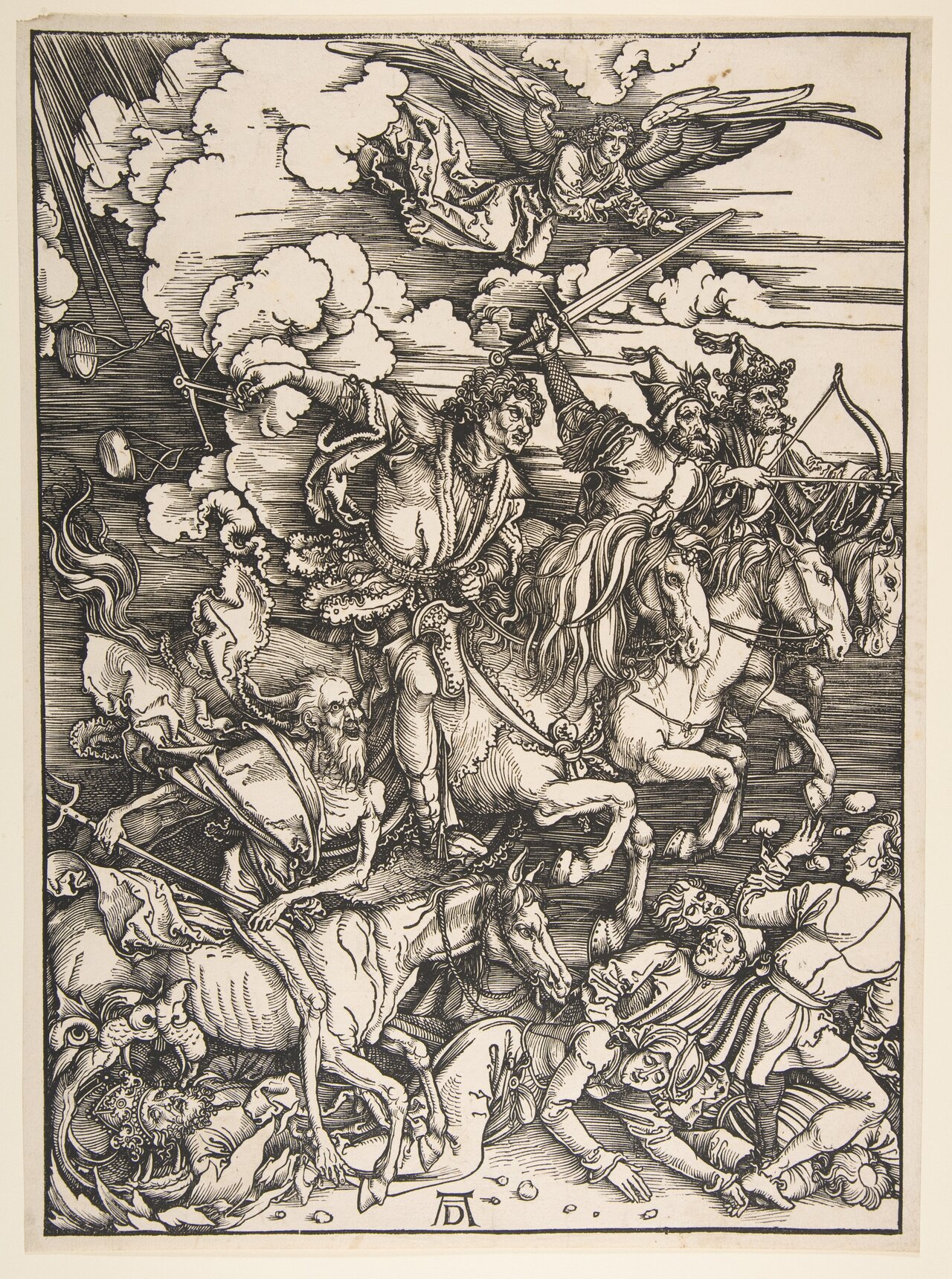
⤢Albrecht Dürer. The Four Horsemen, from the Apocalypse, about 1498 · Albrecht Dürer, CC0 ·Wikimedia Commons
Few engraved cycles on the Revelation of St John survive, and the chief ones are here: Albrecht Dürer, Lucas Cranach the Elder and his workshop, the burin plates of Jean Duvet, the lithographs Odilon Redon made in 1899. Set side by side they show how Dürer’s sheets fixed the look of the end of the world for two centuries, and where the readings parted: the quarrel over faith is legible in the composition itself. Hungarians of the twentieth century close the row, among them Béla Kondor with his Apocalypse with Puppets and Machines of 1956.
significantincluded in museum admission, HUF 5,800
A show about craft rather than masterpieces: what the materials were, what rules were followed, where the hand slipped and how the slip was mended. Among the pieces are a relief recut for the princess Meritaten under Akhenaten, a limestone ostracon covered in practice drawings of the thirteenth to eleventh century BC, and a sculptor’s model of a ram’s head from the Late Period. The core is the museum’s own Egyptian collection, with loans from the Ny Carlsberg Glyptotek in Copenhagen and the Museo Egizio in Turin; the corrections and reuses were found by laboratory work of recent years. Curated by Katalin Anna Kóthay and Flóra Judit Kevély.
For the seventy-fifth year since the first Novgorod letter, found on 26 July 1951 in the Nerevsky dig. More than 1250 have been found since; among them the school exercises of the boy Onfim, with drawings that have no equal in medieval Europe. What the Vindolanda tablets are to Roman Britain, these are to medieval Rus — the writing of ordinary people, kept by wet ground. In the State Rooms, one month only.
A century of the country’s largest photographic service, which shot the news on the day it happened. Shown in two spaces of the Historical Museum: the Resurrection Gate and the Artillery Yard.
A hundred artists, designers and makers from across Russia, chosen by the project’s curator. This year’s theme is the image of the future held by those who work with the inheritance of their forebears. In the exhibition complex on Revolution Square.