Your browser is older than this page. The catalogue still reads here: the list, the filter and the cards all work. Your browser will mark filter choices with plain checkboxes, as best it can. Update your browser to see the page as it was built.
19 June 2026 — 14 June 2027 · Ceramics Space, level −2.
Oven Spirits. Contemporary Approaches, the Eighth
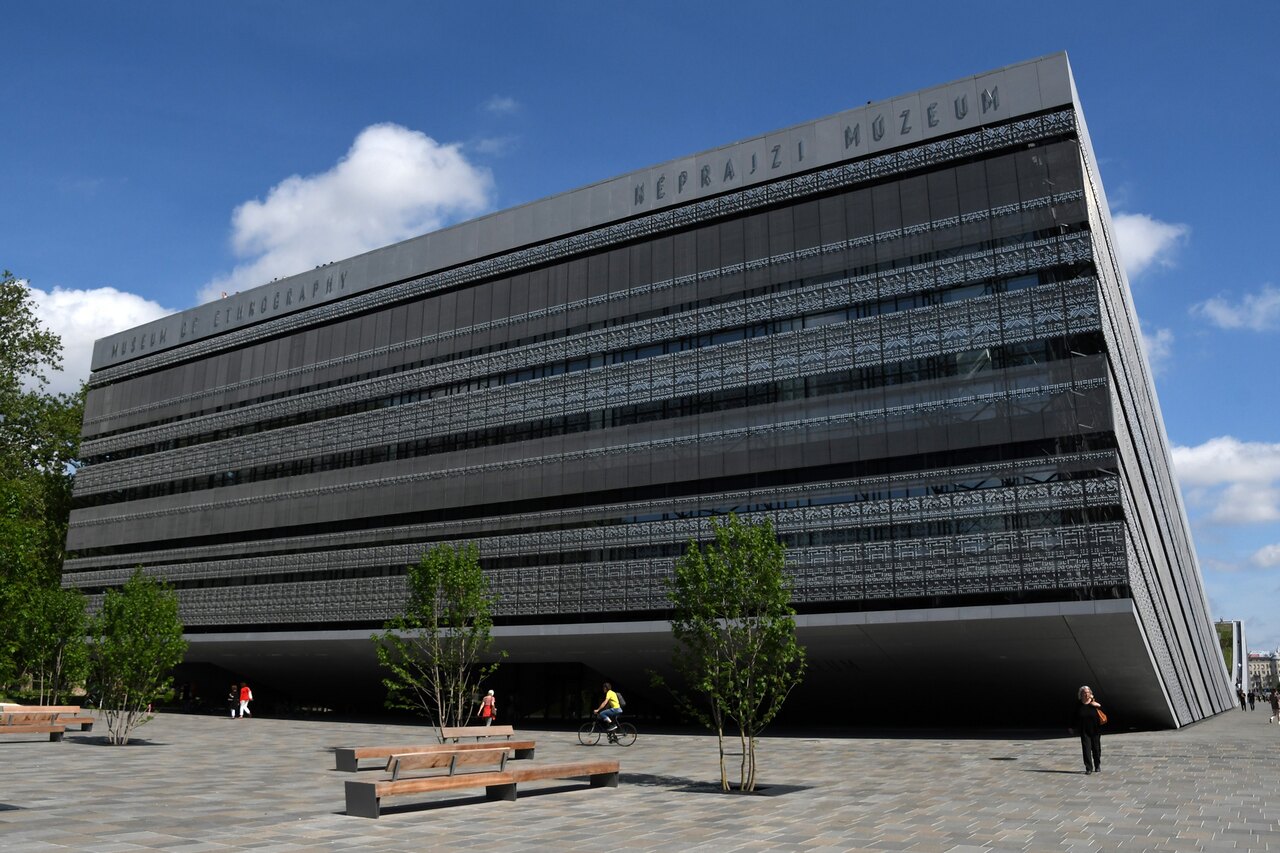
⤢In the photograph, the museum building: Museum of Ethnography · Pasztilla aka Attila Terbócs, CC BY-SA 4.0 ·Wikimedia Commons
The eighth of the museum’s Contemporary Approaches series, in which an artist works with what lies in the collection and sets their own beside it. This time the subject is the oven — the thing that in a peasant house heated, fed and carried half the household on its back. The show stands in the Ceramics Space on level minus two, among the museum’s ceramics of the world, and is set to run for a year and more.
The Belgian anthropologist Gustaaf Verswijver worked among the Mebengokre — whom the outside world calls Kayapó — for half a century, and four years ago gave the museum his archive: forty-seven thousand photographs, ninety hours of film, sound recordings and nearly four hundred objects. This is the first showing out of it. Photographs made between 1974 and 2019 explain what the paint is made of, which myths it points back to, and why a geometric pattern is read by the community at a glance. With them: why Mebengokre men and women stretched ears and lips — the body marked standing and age in the group, not the taste of its owner. Beside Verswijver’s work hang photographs by his wife Martine De Roeck, who went into the field with him.
For the seventy-fifth year since the first Novgorod letter, found on 26 July 1951 in the Nerevsky dig. More than 1250 have been found since; among them the school exercises of the boy Onfim, with drawings that have no equal in medieval Europe. What the Vindolanda tablets are to Roman Britain, these are to medieval Rus — the writing of ordinary people, kept by wet ground. In the State Rooms, one month only.
A century of the country’s largest photographic service, which shot the news on the day it happened. Shown in two spaces of the Historical Museum: the Resurrection Gate and the Artillery Yard.
Tretyakov bought icons in the nineties, a few years before his death. Of this part of his collecting least is known. Sixty-odd panels of the fifteenth to the nineteenth century, many of them shown for the first time: the Novgorod «Predsta Tsaritsa» of the fifteenth century, the Igorevskaya Virgin of Tenderness from the beginning of the sixteenth, work of the tsars’ and the Stroganov masters, got together with the help of dealers and of men who knew old things. Apart from these it is told how the icons came into the rooms of the Gallery and how they travelled Europe in 1929–1932; second floor of the Engineering Building.