Your browser is older than this page. The catalogue still reads here: the list, the filter and the cards all work. Your browser will mark filter choices with plain checkboxes, as best it can. Update your browser to see the page as it was built.
5 March — 31 December 2026 · In the medieval lapidarium.
The Treasures of King Louis the Great
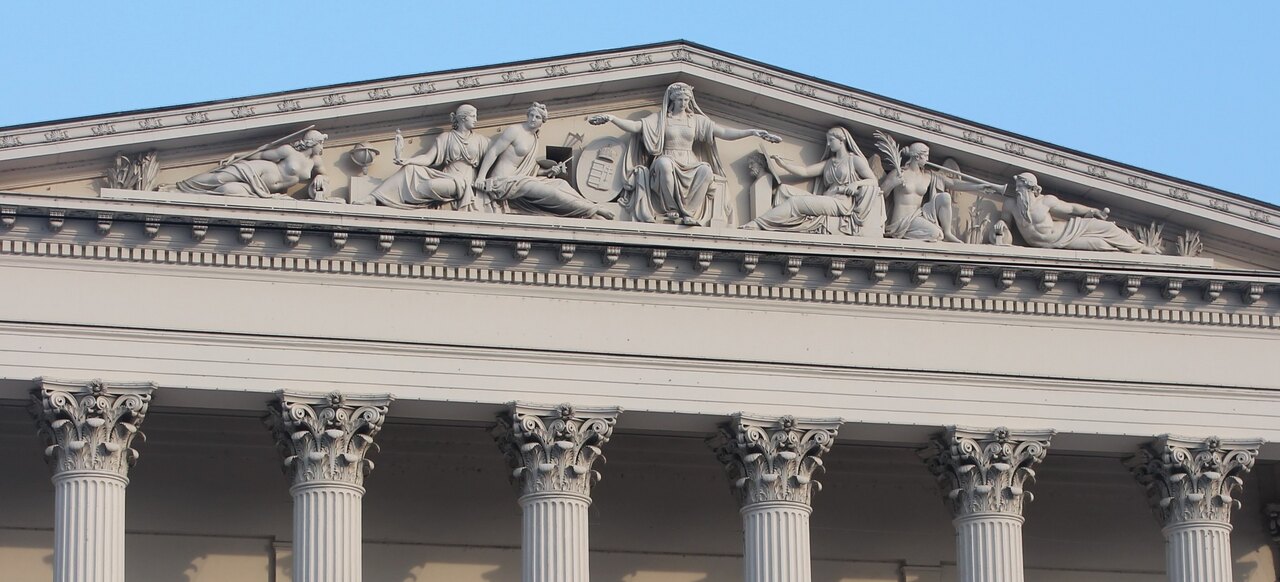
⤢In the photograph, the museum building: National Museum · József Rozsnyai, CC BY-SA 3.0 ·Wikimedia Commons
A small display in the medieval lapidarium, opened on 5 March — the king’s birthday — for the seven hundredth anniversary. Under Louis I, who reigned from 1342 to 1382, Hungary became one of the richest kingdoms in Europe, and the gold mines held it there. Of that wealth a few pieces of goldsmith’s work and the gold florins remain in the country; the rest came out of the ground at Visegrád, where his residence stood. The castles and palaces lie in ruins, and a film in the room puts them together again by computation.
Photographs on boards in the open air, in the Museum Garden, for the same anniversary of the Declaration of Independence as the large show indoors. It can be seen at any hour and without a ticket; for the detail, go inside.
For the two hundred and fiftieth anniversary of the Declaration of Independence — the history of Hungarian emigration and of the diaspora. Millions left: the penniless and the well-off, the adventurous and the fleeing. Some rose; some got hard work and the state of being a stranger and nothing besides; most built the new life in silence. The show is laid out in the most ceremonial parts of the classical building — the grand staircase, the space under the dome and the fireplace rooms.
For the seventy-fifth year since the first Novgorod letter, found on 26 July 1951 in the Nerevsky dig. More than 1250 have been found since; among them the school exercises of the boy Onfim, with drawings that have no equal in medieval Europe. What the Vindolanda tablets are to Roman Britain, these are to medieval Rus — the writing of ordinary people, kept by wet ground. In the State Rooms, one month only.
A century of the country’s largest photographic service, which shot the news on the day it happened. Shown in two spaces of the Historical Museum: the Resurrection Gate and the Artillery Yard.
Tretyakov bought icons in the nineties, a few years before his death. Of this part of his collecting least is known. Sixty-odd panels of the fifteenth to the nineteenth century, many of them shown for the first time: the Novgorod «Predsta Tsaritsa» of the fifteenth century, the Igorevskaya Virgin of Tenderness from the beginning of the sixteenth, work of the tsars’ and the Stroganov masters, got together with the help of dealers and of men who knew old things. Apart from these it is told how the icons came into the rooms of the Gallery and how they travelled Europe in 1929–1932; second floor of the Engineering Building.