Your browser is older than this page. The catalogue still reads here: the list, the filter and the cards all work. Your browser will mark filter choices with plain checkboxes, as best it can. Update your browser to see the page as it was built.
Tretyakov bought icons in the nineties, a few years before his death. Of this part of his collecting least is known. Sixty-odd panels of the fifteenth to the nineteenth century, many of them shown for the first time: the Novgorod «Predsta Tsaritsa» of the fifteenth century, the Igorevskaya Virgin of Tenderness from the beginning of the sixteenth, work of the tsars’ and the Stroganov masters, got together with the help of dealers and of men who knew old things. Apart from these it is told how the icons came into the rooms of the Gallery and how they travelled Europe in 1929–1932; second floor of the Engineering Building.
Fyodor Pryanishnikov, a Petersburg postal official, and Kozma Soldatyonkov, a Moscow merchant and Old Believer, were collecting Russian painting before the Tretyakovs began. Both collections went to the Rumyantsev Museum, and when that was broken up in the twenties they were scattered among the Tretyakov Gallery and fifty-four museums besides. They cannot be put together again. The hang follows the one made before the revolution by Nikolai Romanov, keeper of the Rumyantsev Museum, and a route through the permanent display leads to other things out of the same collections: Tropinin’s Lacemaker, Fedotov’s Breakfast of an Aristocrat, Kiprensky’s Readers of Newspapers in Naples — third floor of the Engineering Building.
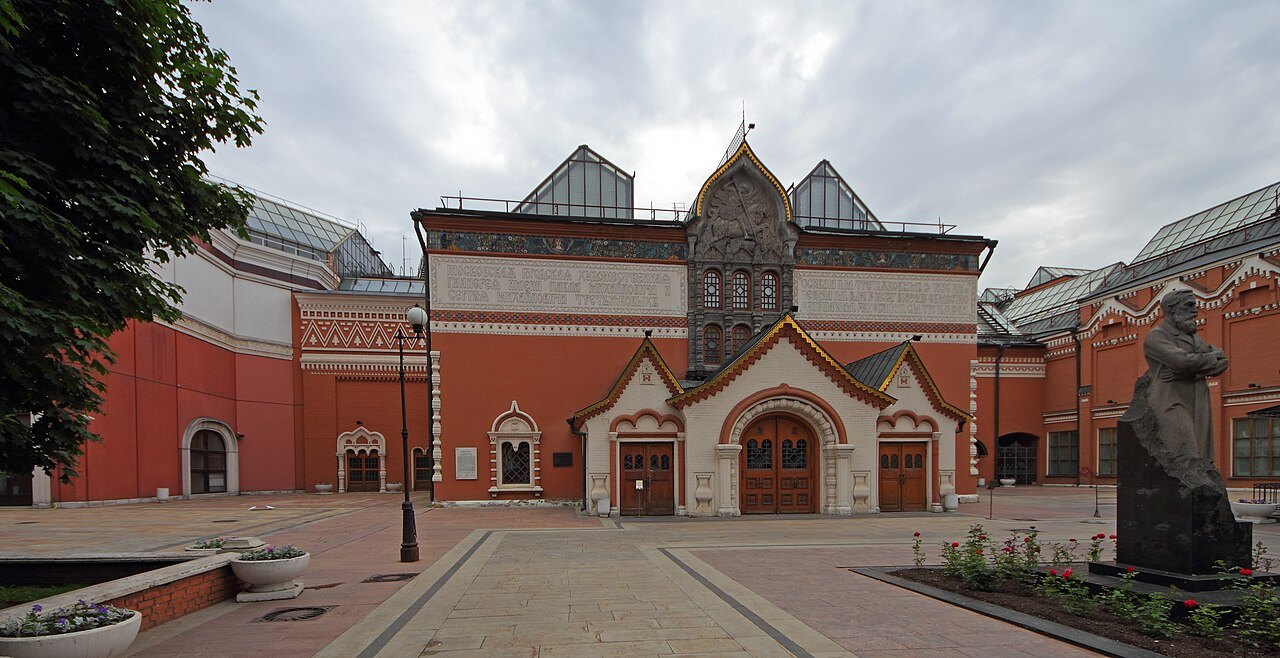
No separate ticket is asked for. Nor were rooms set aside: the route is laid through the permanent display in Lavrushinsky, and nothing was brought here for the occasion — the work has been done in the labels, where beside Savrasov's "The Rooks Have Returned" and Fedotov's "The Major's Courtship" it is now said out of whose hands the picture came into the gallery. The collections of Pryanishnikov and Soldatyonkov are shown whole next door, in the Engineering Building, where the ticket is paid for separately; here in Lavrushinsky only what entered the permanent display is left of them. Those pictures hang beside the ones Tretyakov bought himself.
A hundred artists, designers and makers from across Russia, chosen by the project’s curator. This year’s theme is the image of the future held by those who work with the inheritance of their forebears. In the exhibition complex on Revolution Square.
Over seven hundred objects: sculpture and painting of Russian Buddhism, almost none of it shown before. More than a hundred sculptures were conserved for the opening.
For the seventy-fifth year of Viktor Neplyuev, chief artist of the Gzhel works from 1984 to 1989. Small genre figures in series: porcelain with underglaze painting, made by a man who knows the limits of the craft from inside.